
Live Edge Oak
Include in your email:
- Thickness and sizes, or a cutting list
- Roughly how much you need
- Your Eircode for delivery
Or email us at sales@timberireland.ie
Your security and privacy are at the heart of everything we do. Every purchase you make is protected by industry‑leading safeguards designed to keep your personal and payment information safe.
Secure Payments
Pay with complete confidence using our trusted, fully protected payment methods. Your card details remain secure, uncompromised, and handled with strict care.
All sensitive data is encrypted from end to end, and we never sell or share your card information, ever.
Payment Methods
We accept credit and debit cards from most major credit issuers. Your card can be saved for future purchases and you can remove or edit the card information at any time. For questions regarding your transactions on our site, please consult your card-issuing bank.
We deliver across all four zones defined below.
Quantity savings
Enjoy automatic discounts as soon as your basket qualifies—no codes, no hassle.
Buy 25–49 units
Get 3% off your entire qualifying product order.
Buy 50+ units
Get 5% off your entire qualifying product order.
How it works
Your discount is applied automatically at checkout based on the total quantity of eligible items in your basket. The more you buy, the more you save—simple, transparent, and designed to reward our customers.
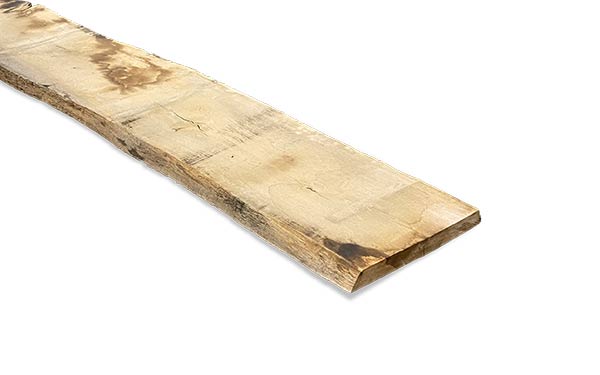
Cut through and through in boule, so consecutive slabs match in colour and figure
Full natural waney edge and width in a single piece, with no glue lines
Held from 38 to 100 mm, kiln and air dried
FSC and PEFC certified supply available on request
Moves seasonally more than most cabinet timbers, so tops must be fixed to float
Reacts with iron and steel wool, leaving blue black staining deep in the fibre
Product specification
- Material
- Timber
- Species
- European Oak
- Wood Type
- Hardwood
Live Edge Oak
A single oak slab makes a table no factory can copy, because the shape of it was decided by the tree. If you are building a dining table, an island top, a mantel or a run of floating shelves, live edge European oak (Quercus robur) gives you width, figure and a natural edge in one piece, with none of the glue lines a made up panel needs. We cut ours through and through from whole logs out of France, Croatia and Poland, so the boards come back to us in boule, every slab in the order it left the log. Stocked in our warehouse for delivery across Ireland, kiln and air dried, with FSC and PEFC certified supply available on request. Sold by the cubic foot and priced on enquiry.
Why European Oak?
Oak earns its place as the default cabinet timber here on three counts. It is hard enough to take daily use without denting, it machines and sands to a genuinely fine surface, and quarter sawn faces carry the medullary ray fleck that no other common species offers. Buying in boule matters more than people expect: consecutive slabs share colour and figure, so a pair of book matched halves actually match, which pulled stock almost never does.
The honest part is that oak moves. It shrinks and swells seasonally more than most cabinet timbers, and a wide slab can change width by several millimetres between a damp autumn and a heated January. That is not a fault to design around, it is a fact to design with, and every technique below exists because of it.
Installation guidance
Give the slab time in the room it will live in before you touch it. Two to three weeks stickered flat, off the floor, with air on both faces, lets it settle to the humidity of the house rather than the workshop. Skipping this is the single most common reason a finished top cups.
When you fix it to a base, let it move. Slotted brackets, figure of eight fasteners or a sliding dovetail all allow the top to expand across its width while staying tight to the frame. Screwing a wide oak top down solid at every point is how you get a split down the middle in the first winter. If the slab has a through shake or a bark inclusion you want to keep, stabilise it with a butterfly key or an epoxy fill before flattening, not after.
Finishing & maintenance
Two routes, both legitimate. A penetrating hardwax oil sits in the timber rather than on it, keeps the surface feeling like wood, and lets you spot repair a ring or a scratch by scuffing back that patch alone and re oiling. Or a lacquer, which gives you a tougher, more spill resistant film and near zero upkeep, at the cost of a repair meaning stripping the whole top. Most of our customers oil a dining table and lacquer a kitchen island, which tracks how hard each one actually gets used.
Whichever you choose, avoid anything containing iron or steel wool on bare oak. The tannin reacts and leaves blue black staining that goes deep into the fibre. We stock finishes suited to oak, so ask us which to pair with yours. For both routes, wipe spills promptly and clean with a damp cloth rather than a wet one.
Browse every species, from oak to walnut, in our hardwood timber range.