
Length
Width
Thickness
Colour Tone
Profile
Material
Fire Rating
Range
Species
Wood Type
Warranty
Moisture Content
Marine Plywood
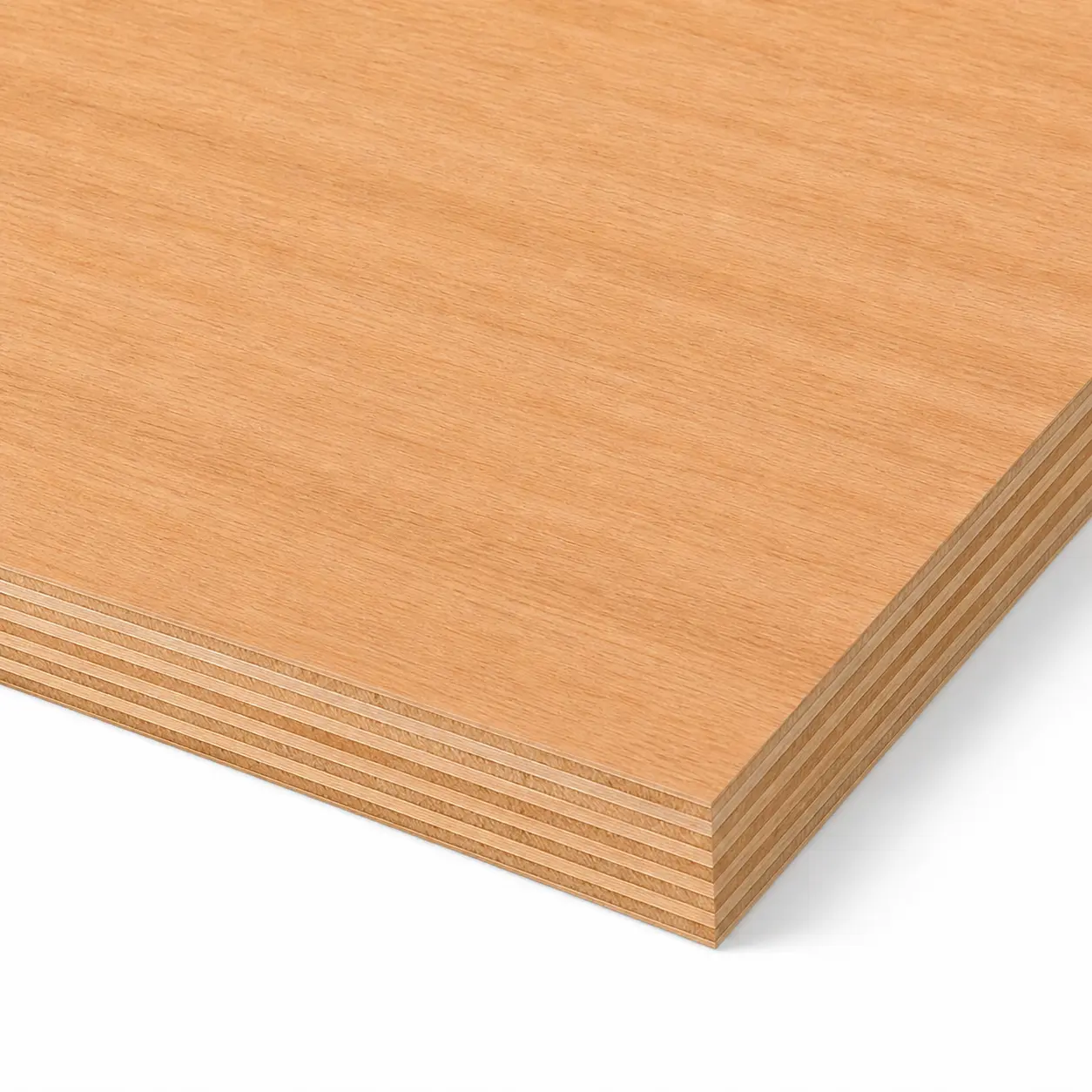
Marine plywood is plywood bonded to survive getting wet without the layers coming apart, for bathrooms, van conversions, boats and outdoor builds. We carry two ranges made to BS 1088: hardwood marine in 12 and 18 mm at 2440×1220 mm, and lighter Tebo okoume from 4 to 18 mm at 2500×1220 mm, stocked in our warehouse and delivered across Ireland.
Sort by

Showing 1-7 of 7 results
What makes a board marine grade
The difference is in the glue and in the layers you cannot see, and neither of them is a coating. Marine plywood is bonded with a fully weatherproof adhesive, so the layers stay stuck together through repeated soaking and drying. Ordinary interior plywood uses a glue that softens once it is properly wet, and after that the sheet swells, the layers separate and it never goes back.
The inside of the board matters just as much. Marine grades are made with no gaps or voids in the middle layers, where a cheaper sheet often has small hollows left behind by a knot that fell out. You do not find them until you cut the board, and every one of them is somewhere water can sit and stay.
How Marine Plywood Handles Water
It is not waterproof timber. It is timber that stays glued together when it is wet, which is a different claim and a smaller one. Left bare and permanently damp it will still go black, still grow mould and eventually still rot. What it will not do is come apart in layers, and that is the failure that ruins a bath panel or a van floor. So it is the right board anywhere damp, but it still wants paint, varnish or oil on every face and every edge before it goes near weather.
BS 1088
Both of the ranges we carry are made to BS 1088, the British Standard for marine plywood. It sets rules for the adhesive, for the quality of every layer including the hidden ones, and for how durable the timber species has to be. Worth checking for, because “marine” on its own is not a protected word and gets used loosely on boards that would not pass.
The two marine plywood ranges
We carry two marine ranges, and the choice between them comes down to weight against strength. Both are BS 1088, both are stocked in our warehouse, and either will outlast an interior board in a wet room.
Hardwood marine plywood
This is the general purpose board, in 12 and 18 mm and the standard 2440×1220 mm sheet, and it is the one to choose when strength matters as much as water does. It is dense and heavy: the 18 mm sheet is 36.4 kg, about the same as birch of the same size, and the 12 mm sheet is 24.3 kg. That density is what lets it hold a hinge screw in a shower seat, or take someone’s full weight on a short span in a room that never dries out properly. It is PEFC certified as well.
Bathroom vanity units are the job it gets bought for most often, followed by a kitchen base unit under the sink, floor panels under tile in a bathroom or utility, worktops in a boot room, garden benches and planters. If you only build one thing in the whole house from a marine board, make it the unit under the sink, because that is where a slow leak nobody notices for a fortnight will destroy a chipboard box and leave this one perfectly serviceable.
Okoume marine plywood
Okoume is a West African hardwood, and this board is okoume the whole way through rather than just on the face. It runs from 4 to 18 mm in a slightly longer 2500×1220 mm sheet, and it is much lighter than the hardwood marine board of the same thickness, which is exactly why boat builders use it. The 18 mm okoume sheet is 26.4 kg against 36.4 kg for hardwood marine, and that is in a bigger sheet. Ten kilos less to carry up a ladder or lift into a van is worth having, and across the four or five sheets a camper conversion uses it changes how the whole job feels.
Being lighter, it is also softer, so it dents more easily and does not grip a screw as firmly. Where something has to carry weight or take daily abrasion the hardwood board is the better buy, and where it has to be lifted, carried or floated the okoume earns the difference. It is also the only one of the two ranges we do thin, at 4 mm, 6 mm and 9 mm, which is the part of the range van and boat work lives on.
Marine plywood thicknesses
Marine plywood is sold by thickness, and picking the right one is mostly about what the board has to carry. Every sheet is 1220 mm wide; okoume sheets are 2500 mm long and hardwood marine sheets 2440 mm.
- 4 mm and 6 mm (okoume): bath panels, linings and curved or clad surfaces where a frame behind carries the load. Thin okoume follows a gentle curve straight off the sheet with no soaking or steaming.
- 9 mm (okoume): the thickness where a board holds a screw properly, for lockers, small cupboards, light furniture and van floors laid over an existing subfloor.
- 12 mm (okoume or hardwood): most cabinets and shelving, including van conversion furniture and bathroom vanity units.
- 18 mm (okoume or hardwood): anything structural, such as a worktop, a floor panel, a bed base or a seat someone will sit on.
If you are replacing something that is already there, measure it rather than working from memory, so the new board lines up with the old one and the fixings still reach.
How much does marine plywood cost?
Marine plywood price comes down to three things: the range, the thickness and the sheet size. Hardwood marine is the denser, heavier board, okoume is the lighter one in a longer 2500 mm sheet, and every step up in thickness adds material. The fair way to compare is by the area you need to cover rather than board against board, since okoume’s longer sheet covers slightly more each time. Enter your area in the calculator on the product page to see how many sheets the job takes, choose the thickness the job needs rather than one step up, and the cart adds the matching extras automatically.
Where it gets used
Bathrooms and utility rooms account for most of what leaves here, from vanity units and bath panels to the framing behind them and anything within splashing distance of a shower. Garden furniture, planters and outdoor kitchens are the next group, then camper van and horsebox conversions, which have become one of the biggest uses for the okoume range now that so many are being built. Boat repairs are the work the board was designed for in the first place and still a steady part of it. It also suits a shed base sitting on bearers close to the ground, or a patch in a garage floor, where the damp is coming up from underneath rather than down from above.
Sealing the edges
This is where marine plywood jobs fail, and it is nearly always the same mistake: the faces get two coats of something and the cut edges get nothing. A cut edge is exposed end grain on every layer at once, and it takes up water many times faster than a face does. Do the edges first, give them an extra coat, and pay particular attention to the bottom edge of anything standing on a floor that gets mopped or rained on. If you are painting, letting a coat of thinned primer soak into the edge before you prime properly makes a real difference. For garden furniture, planters and outdoor kitchens, an exterior oil from our wood oils and stains range soaks into faces and edges alike and is easy to top up each season.
Every hole you drill wants the same treatment, because a screw hole in a wet area is a route straight into the middle of the board. Seal the hole before the screw goes in, and use stainless or hot dip galvanised fixings while you are at it. Plain steel corrodes in exactly the conditions this board is bought for, and it stains the timber around it as it goes.
Marine plywood vs birch and hardwood faced plywood
Marine plywood is the board for anywhere water is part of the job. For furniture and cabinets in a dry room, where a crisp edge is on show, birch plywood gives a pale, even face and a clean layered edge. For structural work indoors that will be covered up, hardwood faced plywood is the everyday board. Where a job sits between the two, in a bathroom, a utility room, a van or anywhere outdoors, marine grade is the one that stays together when it gets wet, which is why most customers building in a damp space choose it from the start.
Marine plywood in Dublin and across Ireland
Both marine ranges are stocked in our Dublin warehouse for collection or delivery across Ireland. An 18 mm sheet in either range is a two person lift, the hardwood board being the heavier of the two at 36.4 kg, and everything at 12 mm and below can be handled on your own. Stack the sheets flat and off the floor until you cut them, so they stay true. The rest of the boards, and how the grades compare, are on the main plywood page.
Frequently Asked Questions About Marine Plywood
What is marine plywood?
Marine plywood is bonded with a fully weatherproof adhesive, so the layers stay together through repeated soaking and drying, and it is made with no voids in the inner layers where water could sit. Both our ranges are made to BS 1088.
How much is marine plywood?
Marine grade costs considerably more than standard plywood, and the current price for each board is on its product page. Enter your area in the calculator on the product page to see how many sheets you need, and measure rather than going thicker than the job needs.
Is marine plywood waterproof?
The glue is, but the timber is not. Left bare and permanently damp it can still go black, grow mould and rot, but the layers will not come apart. Paint, varnish or oil every face and edge before it meets weather.
Should I choose hardwood or okoume marine plywood?
Hardwood marine is dense and heavy, better for daily wear and holding screws, in 12 and 18 mm. Okoume is much lighter, so it suits boats and van conversions, but it dents more easily. It comes from 4 mm to 18 mm.
What thicknesses does marine plywood come in?
Okoume comes in 4, 6, 9, 12 and 18 mm in 2500×1220 mm sheets, and hardwood marine in 12 and 18 mm in 2440×1220 mm sheets. 9 mm is where a board starts holding a screw properly.
What does BS 1088 mean?
BS 1088 is the British Standard for marine plywood. It sets rules for the adhesive, the quality of every layer including the hidden ones, and how durable the timber species has to be. It is worth checking for, because “marine” on its own is not a protected word.