
Length
Width
Thickness
Colour Tone
Profile
Material
Fire Rating
Range
Species
Wood Type
Warranty
Moisture Content
Larch Cladding
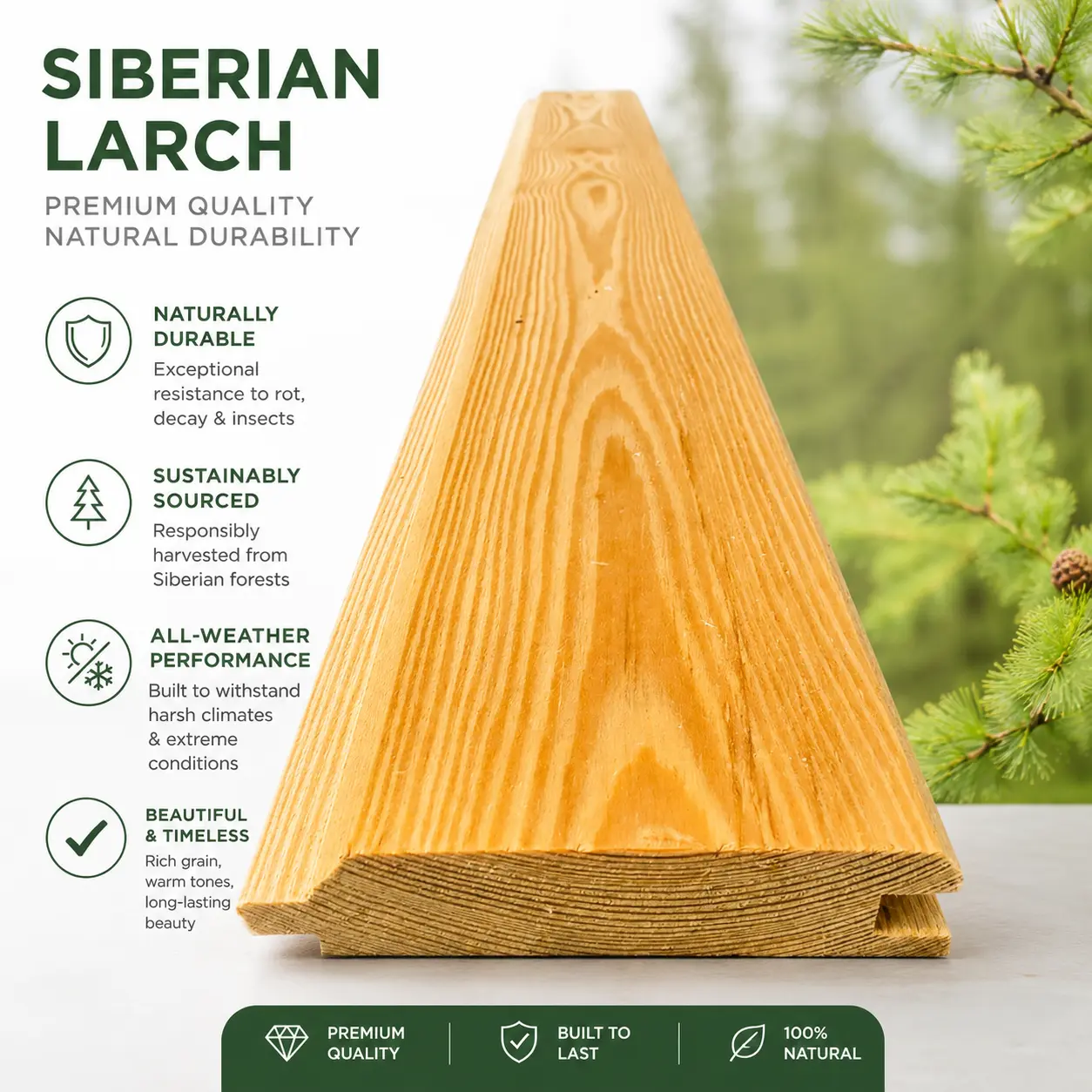
Larch cladding in a 94×18 mm tongue and groove profile. Larch is the toughest of the common European softwoods: Durability Class 3, around 590 kg/m³, with natural resin that keeps the weather out. It has a warm reddish brown colour and lively grain, and every board is stocked in our warehouse for delivery across Ireland.
Sort by
One product found
Larch Cladding for Sale in Ireland
Our larch cladding is larch, machined into a tongue and groove (T&G) profile and stocked in our warehouse for delivery across Ireland. It suits houses, extensions, garden rooms and sheds where you want real timber on the outside without stepping up to a hardwood.
Larch Cladding Board Size and Profile
Every board is 94×18 mm tongue and groove, so the only choice you make is the length. The tongue and groove joint gives a tight, flush face that sheds water, and you can fix it vertically, horizontally or on the diagonal.
Choose the length on the product page. Shorter boards are easier to handle on a ladder or in a van, and suit lower walls, sheds and short runs with less offcut waste. Longer boards mean fewer joints on long elevations and gable ends, so the wall reads as clean, unbroken lines. Whichever you choose, plan each joint to land on a batten.
Why Choose Larch Timber
Larch is the most weather resistant of the common European softwoods.
- Durable: Durability Class 3, with a service life of 20 years and beyond on an exterior wall, much longer than pine or spruce in the same conditions.
- Harder wearing: at around 590 kg/m³ it is closer to a light hardwood than a typical softwood.
- Natural resin: helps the timber shrug off moisture.
- Character: a warm reddish brown with tight, straight grain and small knots that give the facade real presence.
Larch vs Other Cladding Timbers
Larch sits in the middle of our range for durability and look.
Larch or Cedar?
Cedar cladding is lighter, more stable and has a finer, more even colour. Larch is denser and has more knot and grain character. Choose cedar for a refined finish and larch for a more rustic, robust one.
Larch or Douglas Fir?
Douglas Fir cladding is a similar density with a straighter, pinker grain. Larch has the edge on durability outdoors.
Larch or Burnt Larch?
Our charred timber cladding is burnt larch, with its face scorched in the Japanese Shou Sugi Ban style. Choose it for a black facade with a textured, matte finish, and natural larch for the warm reddish brown.
Installing Larch Cladding
- Fix the boards to treated battens over a breather membrane, leaving a ventilated gap of at least 20 mm behind them. Our larch battens match the cladding.
- Use stainless steel ringshank nails or screws. Plain steel reacts with the timber and leaves black stains.
- Pre-drill near the board ends to stop splitting.
- Resin can bleed from fresh cuts. Wipe it off with white spirit; it stops as the timber dries.
- Some fine surface checking is normal as larch settles outdoors.
Oiling Larch Cladding
Larch doesn’t need treating to last, but left bare it weathers to a silver grey within 12 to 18 months. Most people oil it to keep the warm reddish brown. Use a UV protective oil made for softwoods, apply it in the first few months, and refresh it every two or three years. See our wood oils and stains for the right finish.
To compare larch with every other species and profile we stock, browse all our timber cladding.
Frequently Asked Questions About Larch Cladding
How long does larch cladding last?
Larch is rated Durability Class 3, with a service life of 20 years and beyond. That is much longer than pine or spruce in the same exterior conditions, thanks to its higher density (around 590 kg/m³) and natural resin content.
How much larch cladding do I need?
Measure each wall and take off large windows and doors, then enter the area in the calculator on the product page. It works out how many boards you need, and the cart adds the fixings and extras. Choose the length there too: longer boards mean fewer joints on long runs.
What is the best oil for larch cladding?
Use a UV protective oil made for softwoods. Apply it within the first few months and refresh it every two or three years. On weathered larch, a penetrating oil soaks in rather than forming a film. Avoid paint and varnish, which crack as the timber moves. You’ll find suitable finishes in our wood oils and stains.
Does larch cladding need treating?
It doesn’t need treating to last, but untreated larch weathers to a silver grey over about 12 to 18 months. Most people oil it to keep the warm reddish brown, reapplying every two or three years. See our wood oils and stains.
How do I fix Larch cladding?
Use stainless steel ringshank nails or screws to avoid corrosion staining, and pre-drill near the board ends. Resin may bleed from fresh cuts. You can wipe it off with white spirit, and it stops as the timber dries. Some surface checking is normal as the larch settles outdoors.