
Length
Width
Thickness
Colour Tone
Profile
Material
Fire Rating
Range
Species
Wood Type
Warranty
Moisture Content
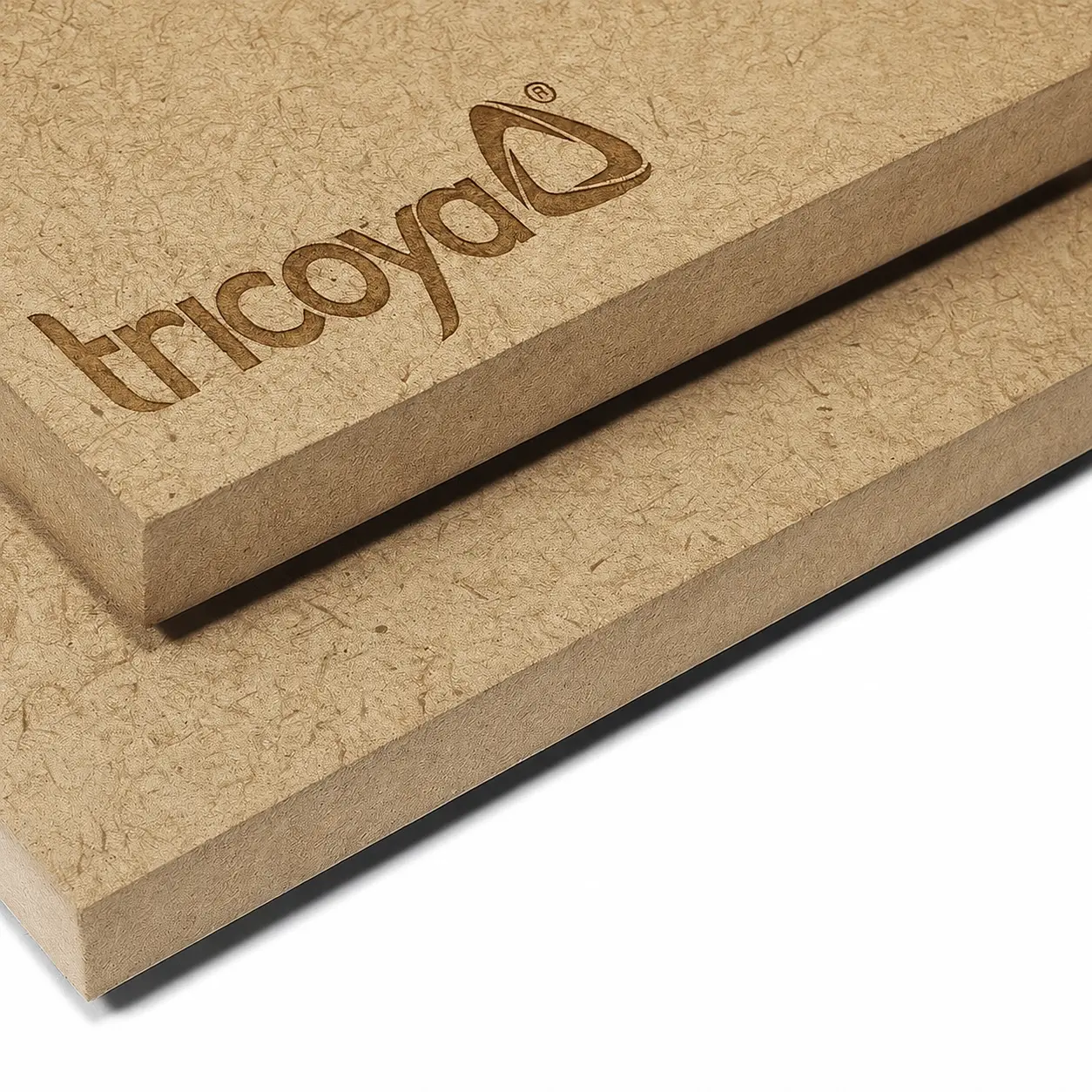
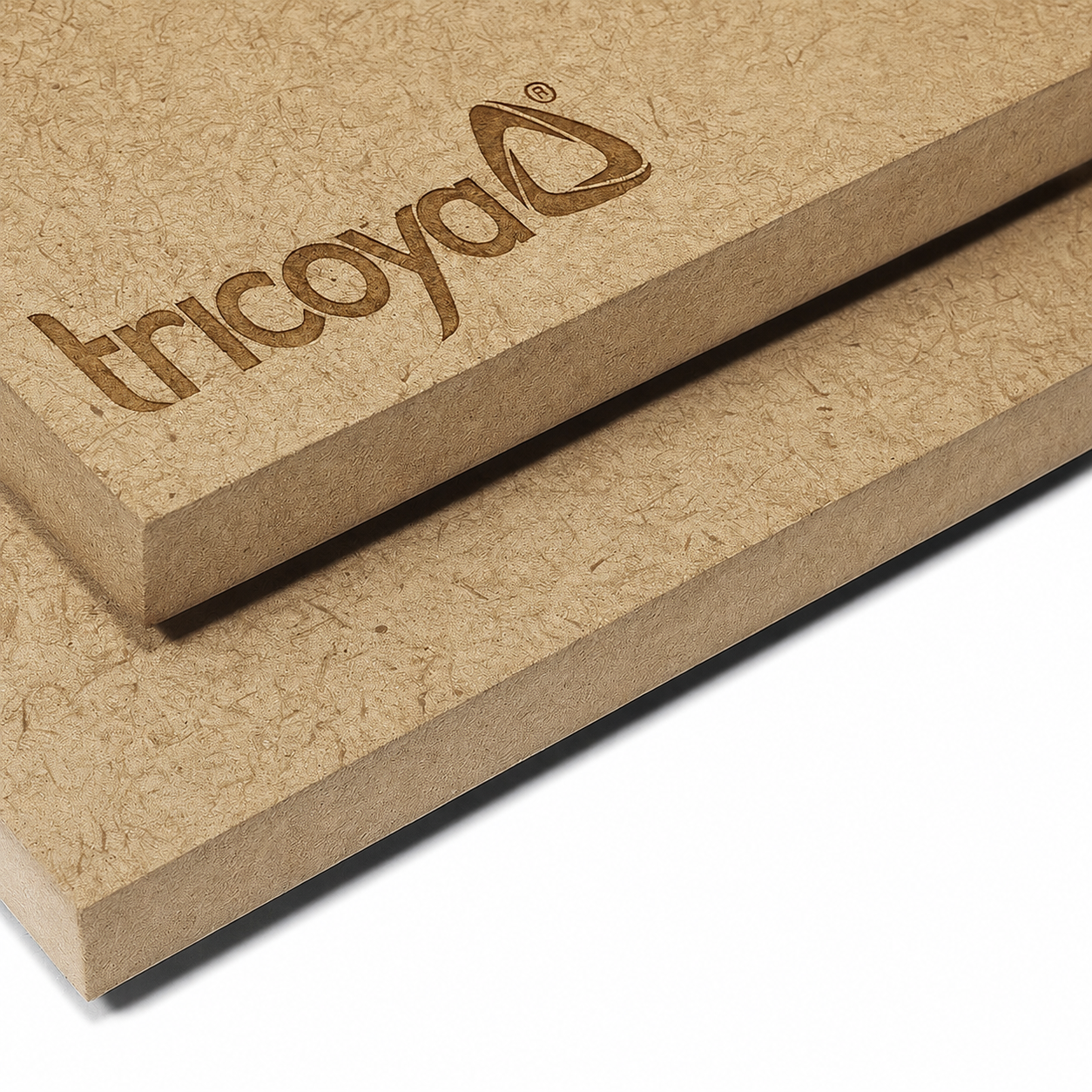
Tricoya MDF Sheets
Tricoya MDF is MDF made from acetylated wood fibre, which lets a painted MDF panel live outdoors and in wet rooms without swelling. It cuts, routs and paints like standard board and is warranted for 50 years above ground, so it suits exterior doors, gates, cladding, soffits and signage. We carry 6 mm, 12 mm and 18 mm in 2440×1220 mm sheets, plus 18 mm in a 3050×1220 mm sheet for tall doors. Held in our North Dublin warehouse for collection or delivery across Ireland.
Sort by
Showing 1-4 of 4 results
What Tricoya MDF is
Tricoya MDF is made from acetylated wood fibre. Acetylation changes the wood itself rather than coating it, and what it changes is how the fibre behaves around water. Untreated fibre takes up moisture, swells, then shrinks as it dries, and that cycle is what finishes ordinary MDF outdoors: the edges thicken, the paint cracks along them and water gets further in. Acetylated fibre absorbs very little water, so the panel stays close to the size it was cut and the paint on it stays intact.
Everything else behaves the way MDF always does. There is no grain, no knots and no voids, so it routs to a crisp profile and paints without grain filling. The panel is warranted for 50 years above ground and resists fungal decay. At around 700 kg per cubic metre it is a little lighter than standard MDF of the same thickness.
Where Tricoya MDF is used
- Exterior doors and gates: build the leaf as a flat panel, rout the detail into it and paint it like interior joinery, without the bottom rail swelling in its first wet winter
- Tricoya cladding and soffits: a flat painted face outside, where a long sheet keeps horizontal joints, the first place water gets behind a face, to a minimum
- Window boards, fascia and enclosures: bin and meter stores and porch panels with nothing behind them that is going to move
- Wet interiors: changing rooms, wet rooms, commercial kitchens and pool surrounds that hold more water in the air than moisture resistant MDF is designed for
- Signage: routed and painted panels that hold their edge detail and colour outdoors
When Tricoya is the wrong board
Indoors and dry, Tricoya is money spent on performance you will never call on, because standard MDF machines and paints the same for a fraction of the cost. It is not a structural panel either: it will not span, and it is not rated for load bearing or bracing work, so a sheet that has to carry load wants plywood.
Tricoya MDF sizes and thicknesses
We carry three thicknesses, and the choice is mostly about what sits behind the panel. A thin sheet is a skin on a frame, while the thickest holds its own shape and carries hinges. Weights are from our product data.
- 6 mm, 2440×1220 mm (12.5 kg): door facings, soffit linings, infill panels and signage fixed to a frame; the 6 mm Tricoya sheet spans nothing on its own, but one person can carry and cut it
- 12 mm, 2440×1220 mm (25 kg): the general purpose thickness, stiff enough to panel an elevation on battens at normal centres; most cladding and wet area joinery uses 12 mm Tricoya MDF
- 18 mm, 2440×1220 mm (37.5 kg): doors, gates, heavy fascia and anything with a hinge or lock in the edge; 18 mm Tricoya MDF is a two person lift
- 18 mm, 3050×1220 mm (46.9 kg): the long 18 mm Tricoya sheet, for door leaves taller than 2440 mm and panels that run a full storey height without a joint
Tricoya MDF price
Tricoya costs a good deal more than standard MDF, because the fibre is acetylated before the board is pressed. Within the range the price rises with thickness and with the long sheet, so compare boards by what you get from them rather than by the sheet.
The saving is usually in the cutting layout. A layout that gets your pieces out of 2440 mm sheets costs less than buying the long sheet for the sake of it, so keep the 3050 mm sheet for tall door leaves and full height panels where a joint would show. Thickness works the same way: buy 18 mm only where the panel carries hardware or has to hold its own shape, and use 12 mm or 6 mm on a frame.
The current price for each thickness and sheet size is on its product page. Enter your area in the calculator there to see how many sheets the job needs, then check whether a different cutting layout gets it out of fewer.
Tricoya MDF vs moisture resistant MDF and plywood
Work out whether the panel will ever be rained on, or sit in air that stays wet for weeks at a time. If it will not, a cheaper board does the job and the difference is better spent on the finish.
- Kitchens and bathrooms: moisture resistant MDF handles damp air and steam at a far lower cost, though not standing water
- Outdoors, wet rooms and hard to replace panels: Tricoya MDF
- Structural sheets: plywood, where the panel has to span, brace or carry load
Detailing Tricoya outdoors
A stable board still needs good detailing, because water that sits in a cut edge sits against the back of your paint film. Most of the work is ten minutes with a brush before the panel goes up.
- Seal every cut edge and drilled hole: use an exterior primer or edge sealer, and do the bottom edge of a door most carefully
- Seal the back: on anything fixed flat to a wall or frame, because it is the face you will never reach again
- Ventilate cladding: leave a ventilated cavity rather than fixing tight against a membrane
- Fixings: use stainless or hot dip galvanised screws, because zinc plated ones rust through the paint long before the panel wears out
- Pilot holes: pilot every fixing near an edge, since MDF of any grade splits if you drive into it dry
- Dust: cut with extraction or outdoors and wear a P2 or P3 mask
Tricoya MDF in Dublin and across Ireland
All four Tricoya MDF sheets are held in our North Dublin warehouse for collection or delivery across Ireland. Plan the route for the long 18 mm sheet before it arrives, because it needs two people and a clear way in. The standard, moisture resistant, fire retardant and veneered grades are in our full range of MDF boards.
Frequently Asked Questions About Tricoya MDF Sheets
Can Tricoya MDF go in ground contact?
The panel carries a 25 year warranty in ground contact against 50 years above ground, but nothing should go into permanent ground contact beyond what the warranty allows. A gate post or a ground level trim detail is still a job for treated timber or a durable hardwood.
Does damage to the paint affect the Tricoya warranty?
No. Damage to the coating does not void the panel warranty, so a scratch or a chip is a cosmetic repair rather than the start of a failure. Paint also lasts noticeably longer on Tricoya than on ordinary MDF, because the board beneath it is not moving with the humidity.
Is Tricoya MDF safe to use indoors?
Yes. It is made with no added formaldehyde, so it can go into wet interiors such as changing rooms and wet rooms. It works perfectly well in a dry room too, and it earns its place anywhere moisture could reach the board.
Is Tricoya MDF waterproof?
It is not a waterproof membrane, but acetylated fibre takes up very little water, so the board stays close to its cut size when it gets wet. Treat it as a stable substrate and let the paint, sealed edges and a ventilated cavity keep water moving off and away from it.