
Length
Width
Thickness
Colour Tone
Profile
Material
Fire Rating
Range
Species
Wood Type
Warranty
Moisture Content
Standard MDF Sheets
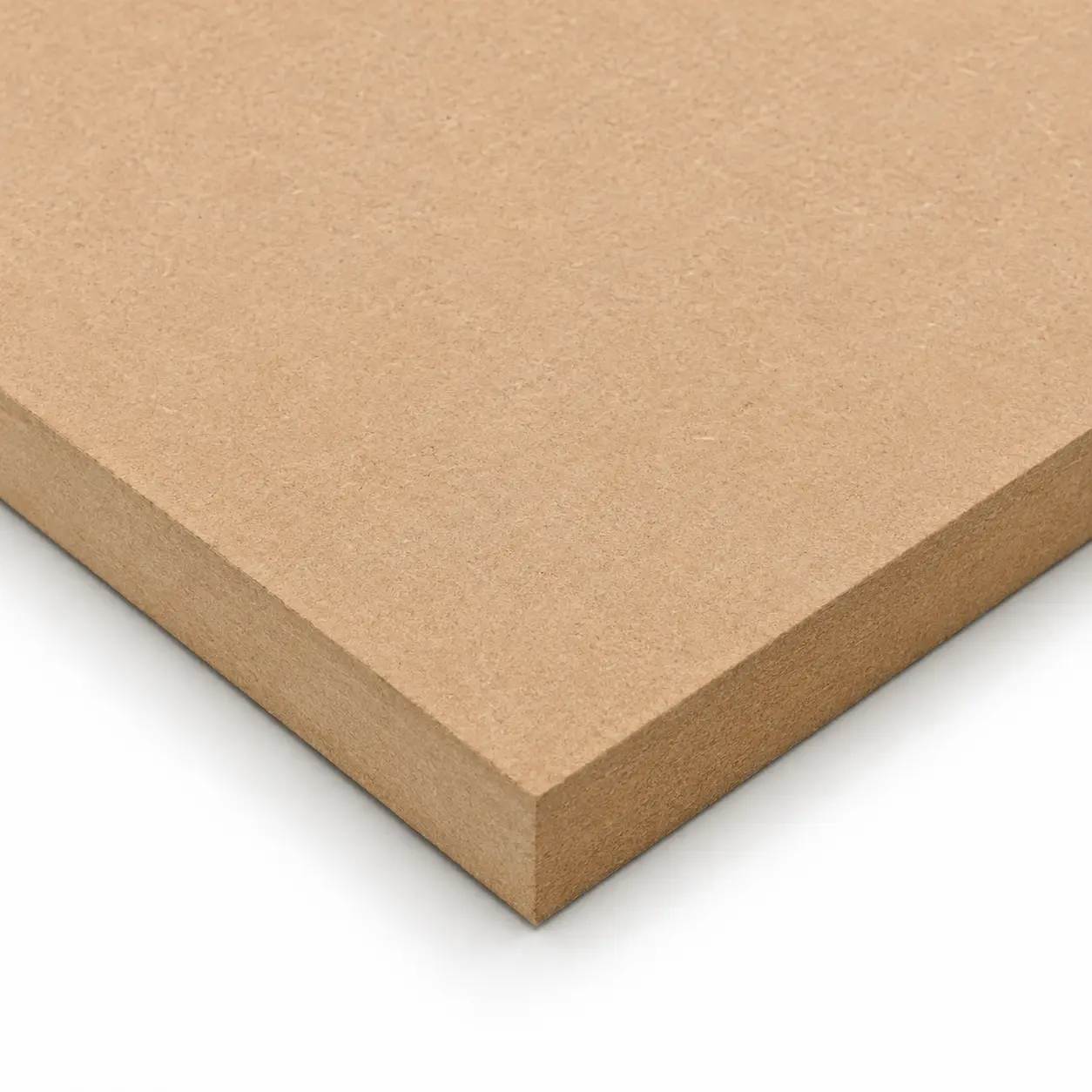
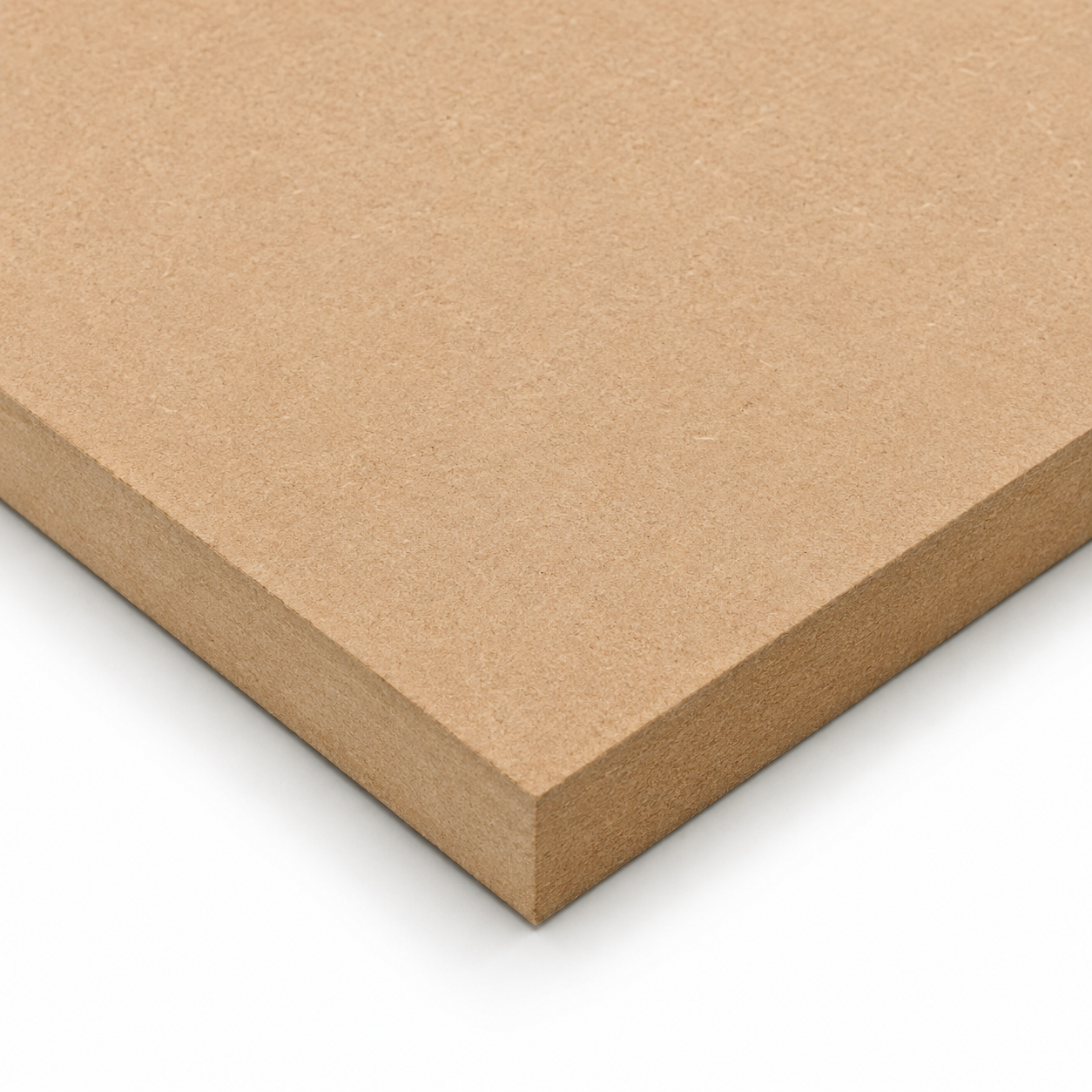
Standard MDF sheets are the flat, knot free board most painted joinery in dry rooms is built from. We carry 21 sheets from 3 mm to 45 mm thick: thin sheets for backs and panelling, 18 mm for anything with doors or drawers, and 25 mm and up for tops that span. Sheets come in 2440×1220 mm, 3050×1220 mm and 3050×1525 mm, plus a 3660×2200 mm CNC sheet. Held in our North Dublin warehouse for collection or delivery across Ireland.
Sort by
Showing 1-12 of 21 results
What standard MDF sheets are
MDF sheets are made from wood broken down into individual fibres, mixed with resin and pressed flat under heat. Because the fibres are so fine, the core is dense and even all the way through, with no knots, no splits and no grain running in any direction. A routed profile comes out crisp, a sanded face takes paint almost as if it were already primed, and the fortieth panel off a cutting list behaves exactly like the first.
That is why standard MDF is what most painted joinery is built from: fitted wardrobes, alcove units, bookcases, radiator covers, window seats and wall panelling. If a drawing simply says MDF, this is the board it means.
It is the wrong board anywhere damp. Once water reaches the core the fibres swell and stay swollen, so a soaked edge never dries back flat and no amount of sanding recovers it. It is also not a structural panel: it will carry weight as a shelf, but it is not a board for floors, roofs or outdoors.
MDF sheet sizes and thicknesses
You choose an MDF sheet on two numbers. The sheet size decides how many joints the job needs, and the thickness decides what the panel can carry and what can be fixed into it. We carry 21 standard MDF sheets, from 3 mm to 45 mm thick and from 2440×1220 mm up to 3660×2200 mm.
MDF sheet sizes in feet and millimetres
Sheets are still called by their old sizes in feet, so an 8×4 is 8 feet by 4 feet. What you buy is measured in millimetres. The standard sheet is 2440×1220 mm, and every thickness from 3 mm to 45 mm comes in it. The larger sizes are there to save joints on tall or deep work:
- 8×4 (2440×1220 mm): the everyday sheet, in 3, 6, 9, 12, 15, 18, 25, 30, 38 and 45 mm, and the easiest to get through a door
- 10×4 (3050×1220 mm): in 6, 12, 15, 18, 25, 30 and 38 mm, so a wardrobe gable or floor to ceiling panel comes out of one piece, with no joint to read through the paint
- 10×5 (3050×1525 mm): in 15, 18 and 25 mm; ripped down the middle it gives two pieces just over 760 mm wide, so deep units come off the 18 mm wide MDF sheet without a wasted strip
- 12×7 oversize (3660×2200 mm): one 19 mm oversize CNC MDF sheet, sized to cover a large format bed so a nest runs in one cycle
Which MDF thickness to choose
Work back from the job rather than forward from a number. Thickness decides whether the board holds a screw in its own edge, whether cabinet hardware fits it, and how far it spans before it sags.
- 3 mm and 6 mm: cabinet backs, drawer bottoms and wall panelling on battens; the 3 mm MDF sheet sits captive in a groove and carries no fixing of its own
- 9 mm and 12 mm: boxing, bath panels and small cupboards; 9 mm holds its shape between battens, and 12 mm is the thinnest edge worth machining
- 15 mm and 18 mm: carcasses, doors and shelving; 18 mm MDF is the default, because hinges, shelf pins and assembly screws are made for that depth
- 25 mm and 30 mm: long shelves and tops that span between supports, with an edge deep enough to shape a bullnose or chamfer straight into the board
- 38 mm and 45 mm: slabs, deep reveals and painted panels that should read as solid
MDF sheet weights
MDF is heavy for its size, at roughly 720 kg per cubic metre, so check the weight before you plan the carry. From our product data, a 2440×1220 mm sheet in 6 mm weighs 12.9 kg, light enough to carry, cut and fit on your own, and 12 mm at 25.7 kg is still one person onto trestles. At 18 mm, 38.6 kg, it becomes two people, or one person with a panel trolley, and from 25 mm (53.6 kg) up to 45 mm (96.4 kg) it is always two people and a clear route in.
The long and wide sheets weigh more again: 48.2 kg for 18 mm at 3050×1220 mm and 60.3 kg at 3050×1525 mm, which will not go through a standard doorway flat.
Standard MDF vs moisture resistant and fire retardant MDF
Every grade of MDF cuts, routs and paints the same way. What differs is what the core is made to survive, so the room decides the grade, not the job.
- Standard MDF: dry interior rooms, and the least expensive grade per sheet
- Moisture resistant: green through the core, for kitchens, bathrooms and utility rooms; see moisture resistant MDF
- Fire retardant: red through the core, for linings and joinery where a drawing names a Euroclass B reaction to fire class; see fire retardant MDF
- Tricoya: acetylated fibre for exterior doors, cladding and soffits, where any other MDF would swell; see Tricoya MDF
The common mistake is a standard sheet in a bathroom because it is going to be painted anyway. Paint fails first at the cut edges and around the fixings, and once the core has swollen it does not come back.
Cutting, fixing and painting MDF sheets
MDF is easy to work with ordinary woodworking tools, but its cut edges behave very differently from its face. The face is dense and smooth, while an edge is open fibre, and most problems with a finished job start there.
- Cutting: use a sharp blade with a high tooth count and support the offcut right through the cut, because the face chips if the panel drops away at the end of a pass
- Dust: MDF dust is very fine and stays in the air far longer than sawdust, so cut outdoors or with extraction and wear a P2 or P3 mask
- Fixing: pilot drill every screw that goes into an edge and keep it back from the corner, since a split cabinet side is a scrap panel
- Routing: run edge profiles in two or three light passes, because one heavy pass burns the core
- Painting: prime cut edges with a primer made for MDF, let them dry and give them a second coat before the faces get anything, because an edge drinks finish several times faster than the face
Keep water based paint off bare board until it is primed. The water lifts the fibres and leaves a furry surface that has to be cut back before you can carry on.
MDF sheets in Dublin and across Ireland
Every standard MDF sheet on this page is held in our North Dublin warehouse for collection or delivery across Ireland. Pick the thickness from the grid, choose the sheet size on the product page, and use the calculator there to work out how many sheets the job needs. To compare the other grades side by side, see our full range of MDF boards.
Frequently Asked Questions About Standard MDF Sheets
What thickness of MDF should I use for shelves?
18 mm suits most shelving, but a loaded 18 mm shelf will sag over a clear span of about 900 mm. For longer spans use 25 mm, or add a batten, lipping or bearer under the 18 mm board.
Can I screw into the edge of an MDF sheet?
Not into the thin sheets: 3 mm and 6 mm need a groove or a frame to live in. From 15 mm an edge will take an assembly screw, and 18 mm is the shallowest board that holds one at full depth without bursting through a face. Always pilot drill and keep fixings back from corners.
What size do MDF sheets come in?
The standard MDF sheet is 2440×1220 mm, the old 8×4, and every thickness from 3 mm to 45 mm comes in it. Selected thicknesses also come in 3050×1220 mm (10×4) and 3050×1525 mm (10×5) to save joints on tall or deep work, and there is one 19 mm oversize CNC sheet at 3660×2200 mm.
How many MDF sheets do I need?
Use the calculator on the product page: enter the area you need to cover and it works out the number of sheets. The 3050 mm long and wide sheets cover more each and save joints on tall or deep work. Allow extra for offcuts on a cutting list.
What is the difference between MDF and chipboard?
MDF is pressed from individual wood fibres, while chipboard is pressed from chips and flakes. The finer fibre gives MDF a dense, even core with no voids, so a routed edge comes out crisp and a sanded face takes paint well.
Is standard MDF low in formaldehyde?
Yes. Our standard MDF is L-MDF to EN 622-5, the grade for non load bearing use in dry conditions, with the E1 low formaldehyde classification, so it suits fitted furniture and joinery in homes.