
Length
Width
Thickness
Colour Tone
Profile
Material
Fire Rating
Range
Species
Wood Type
Warranty
Moisture Content
Fire Retardant MDF Sheets
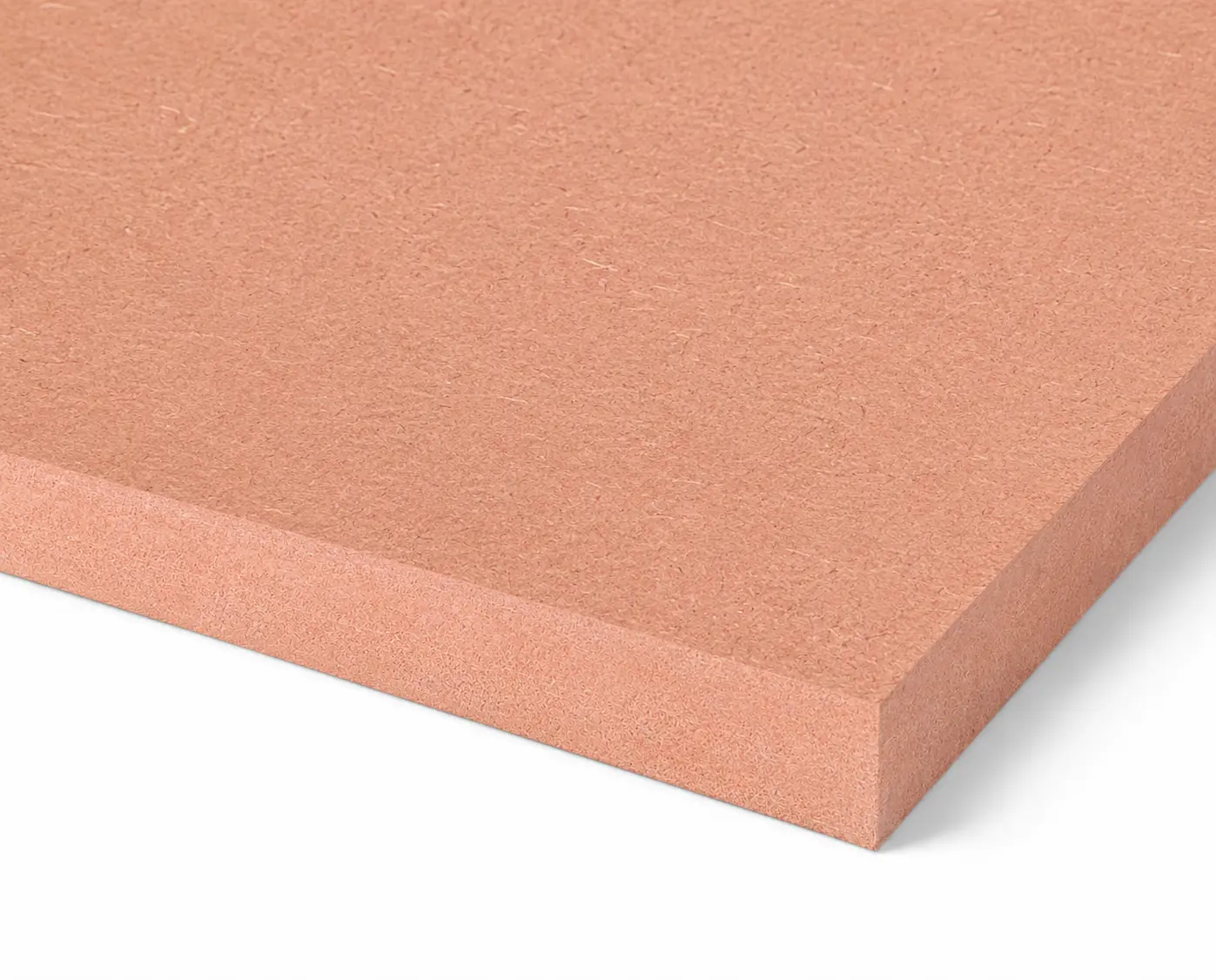
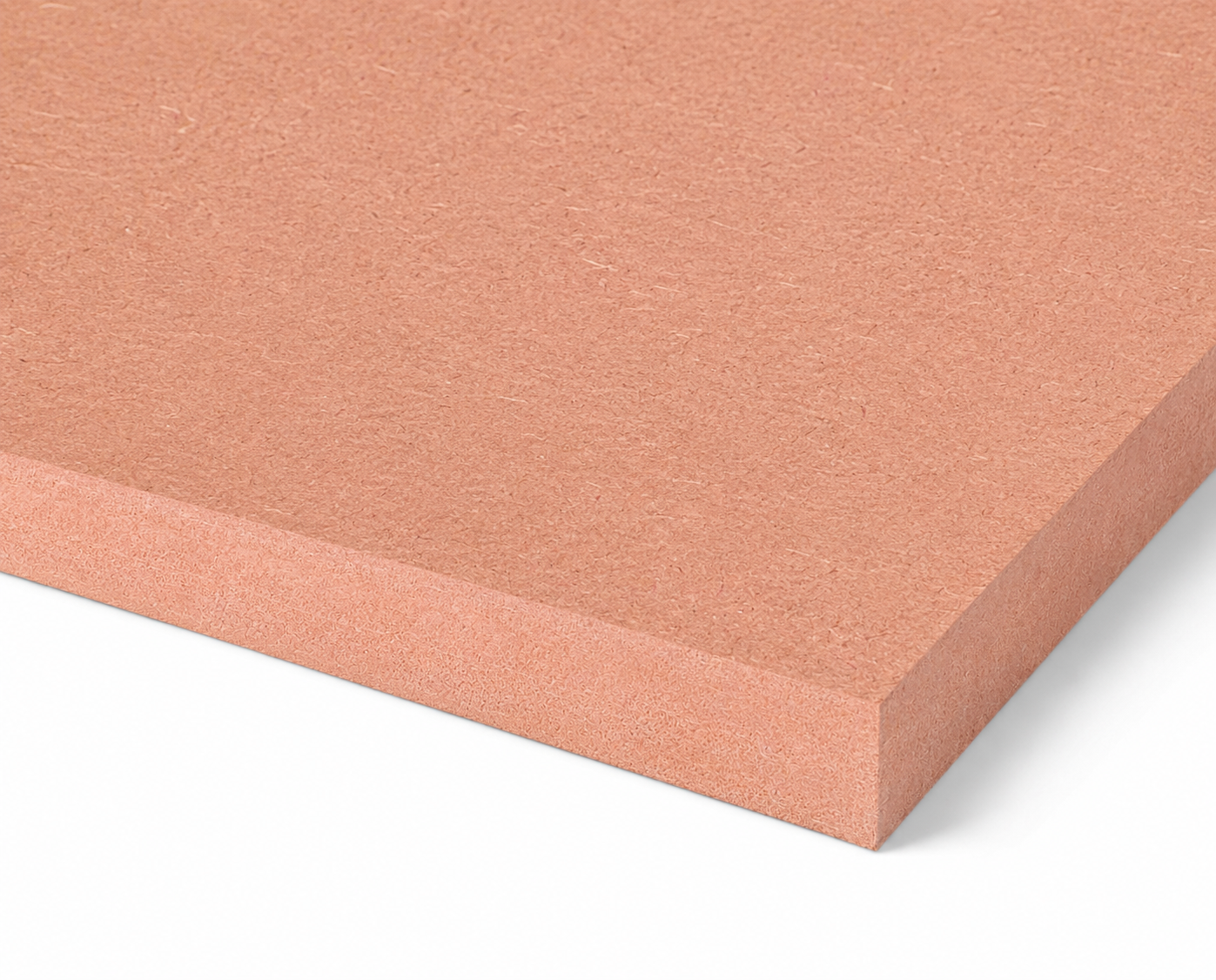
Fire retardant MDF is MDF with the fire retardant worked into the board and a red dye right through it, for linings, ceilings, joinery and counters where a drawing names a reaction to fire class. The whole range is classified Euroclass B, the best class a timber based panel can reach. We carry eight thicknesses from 6 mm to 30 mm, each in a 2440×1220 mm sheet and a 3050×1220 mm sheet. Held in our North Dublin warehouse for collection or delivery across Ireland.
Sort by
Showing 1-12 of 16 results
What fire retardant MDF is
Fire retardant MDF is medium density fibreboard with the fire retardant worked into the panel as it is pressed, so the protection is part of the board rather than a coating on it. You cannot sand it off, and cutting a sheet in half does not leave an untreated edge. That is why it is specified instead of an intumescent paint brushed onto plain board, which protects only for as long as nobody rubs it down.
Every sheet is dyed red right through its thickness. Where rated and ordinary panels are stacked in the same room, the red core lets an inspector see at a glance which board went into the wall, and it lets you check months later. It machines like MDF, so it goes into wall and ceiling linings, doors, partitions, reception counters and joinery in schools, hotels and public buildings.
It is the wrong board anywhere damp. Water swells the core for good and it never comes back, so kitchens, bathrooms and anywhere that gets washed down need a moisture resistant panel. It is also not load bearing, however thick you buy it: a 30 mm board is a heavy panel, not a structural one.
Reading a fire rated MDF classification
People search for fire rated MDF, fire resistant MDF and fireproof MDF, but the classification on these boards answers one specific question: how a surface behaves when a fire reaches it. The rating comes from EN 13501-1, the European reaction to fire standard, and it looks like B-s1,d0. That is three pieces of information, not one code.
What B-s1,d0 means
- B (the class): how readily it catches and how much it adds to a fire, on a scale from A1 (does not burn) down to F; wood burns, so B is the best a timber panel can reach, where untreated MDF sits at D or E
- s1 or s2 (smoke): s1 is almost no smoke and s2 a limited amount; on an escape route smoke often matters more than the letter in front
- d0 (droplets): nothing burning falls from the board, which is why ceilings and soffits get checked first
Reaction to fire is not fire resistance
Fire resistance is a different measurement: how long a wall, floor or door holds a fire back, given in minutes. Fire retardant MDF is a reaction to fire product. It stops a corridor lining carrying flame along its length, but it does not replace a fire rated plasterboard wall or a fire door. If a drawing says a partition must hold for 30 or 60 minutes, that figure belongs to the whole wall build up, not to the panel on its face.
Fire retardant MDF thicknesses and sheet sizes
Every thickness is Euroclass B. The smoke figure is stated per thickness in our product data, so check the product page when your specification names one. The board is dense, at about 780 kg per cubic metre, so weights are given for the 2440×1220 mm sheet.
- 6 mm: surfaces that need a rating without adding depth, on continuous backing or battens at close centres
- 9 mm (20.9 kg): duct casings and ceiling panels, the first thickness that holds its shape between normal batten centres
- 12 mm (27.9 kg, B-s2,d0): most commercial wall linings, and still light enough for one person to get onto trestles; see the 12 mm fire rated MDF
- 15 mm and 18 mm (34.8 kg and 41.8 kg, B-s1,d0): cabinets and joinery; 18 mm fire retardant MDF is the thickness hardware is designed around and the one most orders are for
- 22 mm and 25 mm (51.1 kg and 58.0 kg, B-s1,d0): counters, shelving and reception desks, with enough edge to machine a chamfer or bullnose
- 30 mm (69.7 kg): bench seating, column casings and deep reveals, where a panel has to read as solid
Every thickness also comes in a 3050×1220 mm sheet, which covers a storey height in one piece. A horizontal joint you avoid in a corridor is one you never fill, sand or see in raking light, and the 12 mm fire retardant MDF at 3050 mm takes a stairwell from skirting to ceiling. Measure the route through the door and up the stairs before the long sheets arrive.
Fire retardant MDF vs other boards
If the job does not need a rating, you are paying for something it will not use, so match the board to the specification rather than buying red board to be safe.
- No fire class needed, dry room: standard MDF sheets machine and paint the same
- Damp room: moisture resistant MDF, which carries no fire class, so check which property the specification puts first
- A rated panel that is lighter or holds a screw in its edge: fire retardant plywood
Working with fire retardant MDF
It cuts like MDF, only denser, so it blunts blades faster than standard board. The finish you put on its face also matters, because it can change how the whole build up is classified.
- Cutting: use a sharp tungsten carbide tipped blade with plenty of teeth, let it feed at its own rate and keep a spare blade for a long cutting list
- Support: hold the sheet along the cut line rather than at its ends, or it drops into the blade
- Dust: the red dust is fine and travels, so cut outdoors or with extraction and wear a P2 or P3 mask
- Priming: two coats of a dedicated MDF primer, sanded between, on edges as well as faces, and a third on any machined edge left on show
- Finishes: a heavy combustible laminate or decorative film can pull the assembly out of its class even though the panel is rated, so check the finish against the fire specification before it is bonded down
Fire retardant MDF in Dublin and across Ireland
Every fire retardant MDF sheet on this page is held in our North Dublin warehouse for collection or delivery across Ireland. Pick the thickness from the grid, choose the sheet length on the product page and use the calculator there to work out how many sheets the job needs. The other grades are in our full range of MDF boards.
Frequently Asked Questions About Fire Retardant MDF Sheets
Is fire retardant MDF fireproof?
No board made from wood is fireproof. Fire retardant MDF is classified Euroclass B, so it is slow to catch and adds very little to a fire, where untreated MDF sits at D or E. It does not give a wall or door a fire resistance time in minutes.
How heavy is fire retardant MDF?
It is denser than standard MDF. An 18 mm sheet of 2440×1220 mm weighs 41.8 kg, against 38.6 kg for standard board, and the 3050×1220 mm sheets run from 17.4 kg at 6 mm to 87.1 kg at 30 mm, so the thicker long sheets need two people.
Can I paint fire retardant MDF?
Yes, it paints like any MDF once primed. Ordinary paint is fine, but a heavy combustible laminate or decorative film bonded to the face can take the finished build up out of its classification, because the rating belongs to the whole assembly rather than the panel alone.
Does fire retardant MDF have a data sheet?
Each product page lists the thickness, sheet size, weight and the classification stated for that board. Check the page for the exact thickness you are buying, because the smoke figure in the rating can change from one thickness to the next.
Can fire retardant MDF be used outside?
No. It is a dry interior board, and water swells the core for good. For a painted panel outdoors, Tricoya MDF is the grade made for exterior work, though it is not a fire rated board.