
Length
Width
Thickness
Colour Tone
Profile
Material
Fire Rating
Range
Species
Wood Type
Warranty
Moisture Content
Moisture Resistant MDF Sheets
Moisture resistant MDF is the green MDF board for kitchens, bathrooms, utility rooms and other damp rooms. It resists humid air rather than standing water, so it is not for showers or outdoor work. We carry 20 sheets from 6 mm to 38 mm in 2440×1220 mm and 3050×1220 mm, plus a wide 3050×1525 mm sheet in 12 mm and 18 mm. Held in our North Dublin warehouse for collection or delivery across Ireland.
Sort by
Showing 1-12 of 20 results
What moisture resistant MDF is
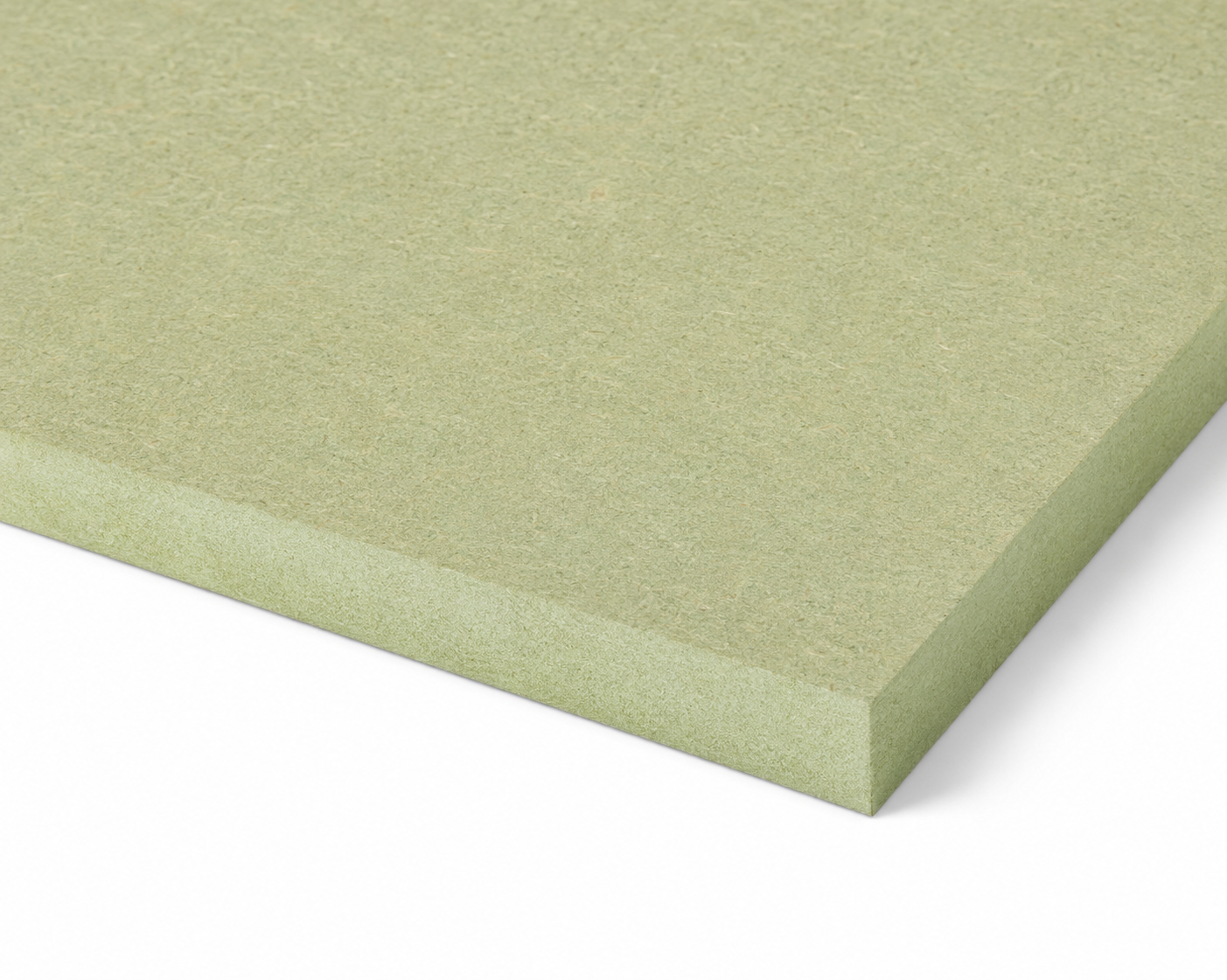
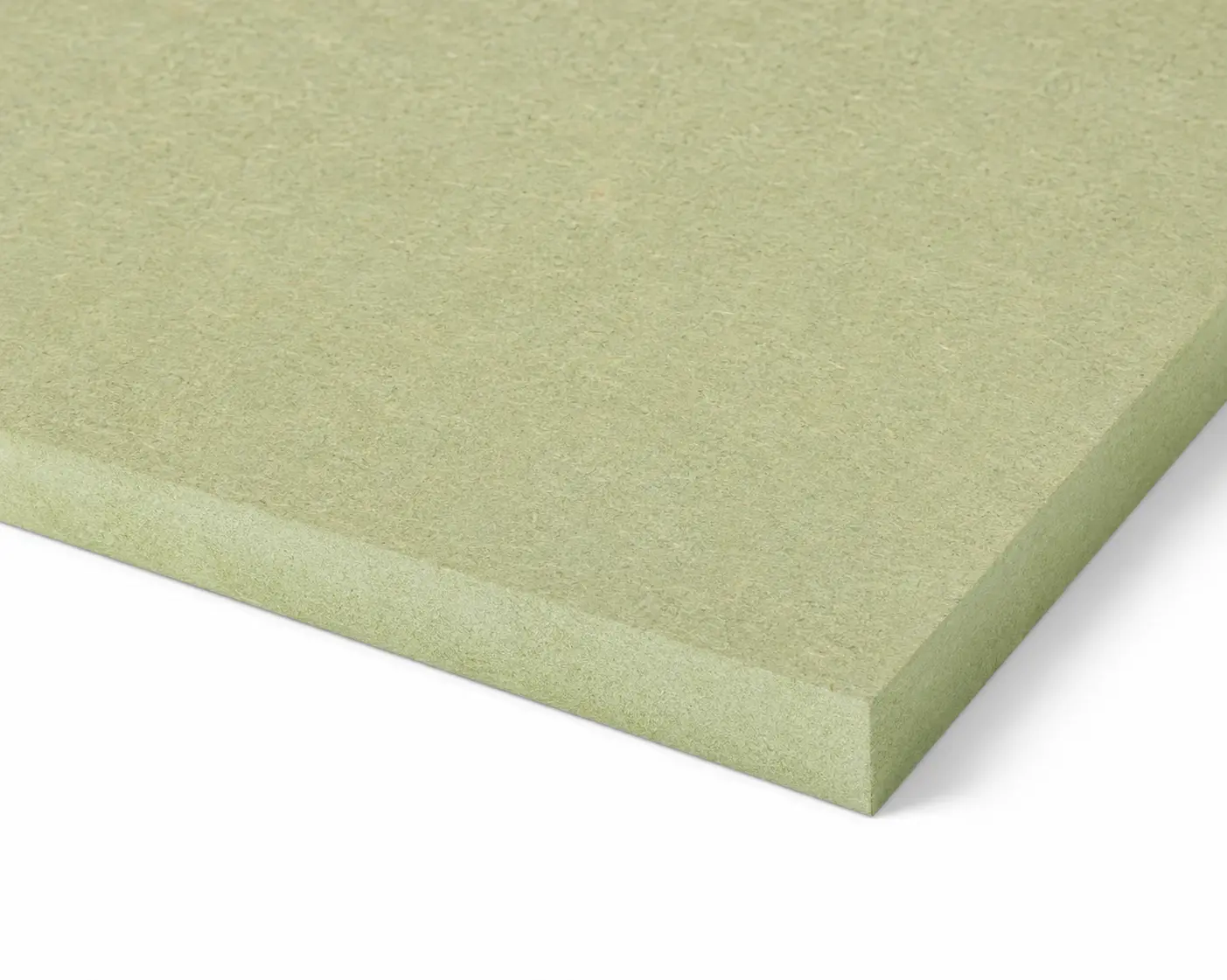
Moisture resistant MDF is medium density fibreboard made with a moisture repellent resin in place of the usual binder. The resin carries a green dye, so the board is green right through its thickness, and anyone on the job can see at a glance that the right sheet went into the bathroom. Green MDF, MR MDF and moisture resistant board all mean this same product.
It cuts, routs, sands and paints exactly like a standard sheet, so nothing about the way you work has to change. What changes is how it copes with damp air. A standard sheet in a steamy room slowly swells, softens at the edges and loses its flatness. This one stays flat in a bathroom that fills with steam twice a day, a kitchen, a utility room or an unheated space that runs through condensation.
Humidity, Not Water
It is worth being precise about this, because the name promises more than the board delivers. It resists humidity. It does not resist water. Left with water pooling against a cut edge it swells like any other fibreboard, just more slowly, so it does not belong in a shower lining, a wet room floor or anywhere outdoors. If the panel will be genuinely wet rather than damp, choose Tricoya MDF, which is made for exterior and wet use.
MR MDF thicknesses and sheet sizes
We carry the green range in nine thicknesses from 6 mm to 38 mm. Every thickness comes in the 2440×1220 mm sheet, the one old trade names call an 8×4 because it is roughly 8 by 4 feet, and in the 3050×1220 mm 10×4 sheet. Choose the thickness by what the panel has to do, then the sheet by how many joints you want.
Which thickness to choose
Thin sheets need support behind them, while the thicker ones hold hardware and span. Weights are for a 2440×1220 mm sheet, from our product data.
- 6 mm and 9 mm: backs, infill, linings and boxing for pipe runs and concealed cisterns; the 6 mm moisture resistant MDF sheet needs support behind it, while 9 mm (20.4 kg) holds its shape between battens
- 12 mm and 15 mm: bath panels, splashback substrates, cistern casings and moisture resistant MDF panelling; the 12 mm MR MDF sheet (27.1 kg) is the general purpose thickness
- 18 mm: vanity units, bathroom and kitchen cabinets, doors and drawer fronts; 18 mm moisture resistant MDF (40.7 kg) is what a drawing assumes if it gives no thickness
- 22 mm and 25 mm: bases under laminate or tiled tops, vanity tops that span between units, and benching (49.8 kg and 56.6 kg)
- 30 mm and 38 mm: slabs bought when a deep profile is machined straight into the edge (67.9 kg and 86.0 kg)
Sheet sizes
The longer and wider sheets exist to save joints, and a joint you avoid in a bathroom is one that never has to be filled, sanded and sealed against steam.
- 8×4 (2440×1220 mm): all nine thicknesses, and the sheet to buy unless the job says otherwise
- 10×4 (3050×1220 mm): all nine thicknesses, for full height panelling, tall cistern casings and floor to ceiling cupboard fronts in one piece
- 10×5 (3050×1525 mm): 12 mm and 18 mm; the wide 18 mm MR MDF sheet rips into two pieces just over 760 mm wide, so deep vanity units come off it without a wasted strip
Moisture resistant MDF vs standard MDF and Tricoya
The three grades machine and paint the same way. The choice comes down to how wet the panel will get over its life, and the common mistake is to put a standard sheet in a bathroom because it is going to be painted anyway. Paint fails at the edges and fixings long before the room stops being humid.
- Dry rooms: standard MDF sheets, because the green grade is money spent on a problem you do not have
- Damp rooms: moisture resistant MDF, for steam, condensation and the occasional splash
- Wet or outdoor work: Tricoya MDF, for exterior panels, wet rooms and anywhere replacing the panel would be difficult
Fitting MR MDF in bathrooms and kitchens
The board is only half the specification. Most failures in a damp room start at a cut edge or a fixing, so detail those as carefully as you choose the sheet.
- Seal every cut edge: use a thinned primer, an edge sealer or a lipping before the panel goes in, paying most attention to bottom edges on mopped floors and cut outs around taps, wastes and pipes
- Tiling: seal the board first and use a flexible adhesive, because the board still moves slightly with humidity and a rigid adhesive over unsealed board is a common reason tiles lift along a bath
- Fixings: use stainless or properly plated screws, hinges, runners and shelf supports, since bright zinc rusts and bleeds through the paint
- Machining: use tungsten carbide tooling, pilot drill near edges and use coarse threaded MDF screws
- Dust: cut with extraction, wear an FFP3 mask and vacuum rather than sweep
- Painting: use a primer made for MDF and prime the edges before the faces, because in a bathroom the coating does as much of the protecting as the board
MR MDF in Dublin and across Ireland
Every moisture resistant MDF sheet on this page is held in our North Dublin warehouse for collection or delivery across Ireland. Pick the thickness from the grid, choose the sheet size on the product page, and use the calculator there to work out how many sheets the job needs. The other grades, from standard to fire retardant and veneered board, are in our full range of MDF boards.
Frequently Asked Questions About Moisture Resistant MDF Sheets
Can I use moisture resistant MDF for skirting boards?
Yes, it suits skirting in kitchens, bathrooms and utility rooms, where floors are mopped and the air is damp. We sell it as full sheets rather than machined skirting, so rip and profile it to your own section, and seal the bottom edge before it goes on the floor.
Is moisture resistant MDF heavier than standard MDF?
Slightly. An 18 mm sheet of 2440×1220 mm moisture resistant MDF weighs 40.7 kg, against 38.6 kg for the same standard sheet. It is still a two person lift, or one person with a panel trolley, and each product page lists the sheet weight.
Is moisture resistant MDF also fire rated?
No. The green board resists damp air but carries no fire classification, and the red fire retardant board is a dry interior panel. Moisture resistance and a fire rating do not come in the same sheet in our range, so check which one your specification needs first.
How many sheets of MR MDF do I need?
Enter your area in the calculator on the product page and it works out the number of sheets. The 3050 mm sheets cover more each and save joints on tall panels, and on a cutting list allow extra for offcuts.