
Length
Width
Thickness
Colour Tone
Profile
Material
Fire Rating
Range
Species
Wood Type
Warranty
Moisture Content
Oak Veneered Plywood
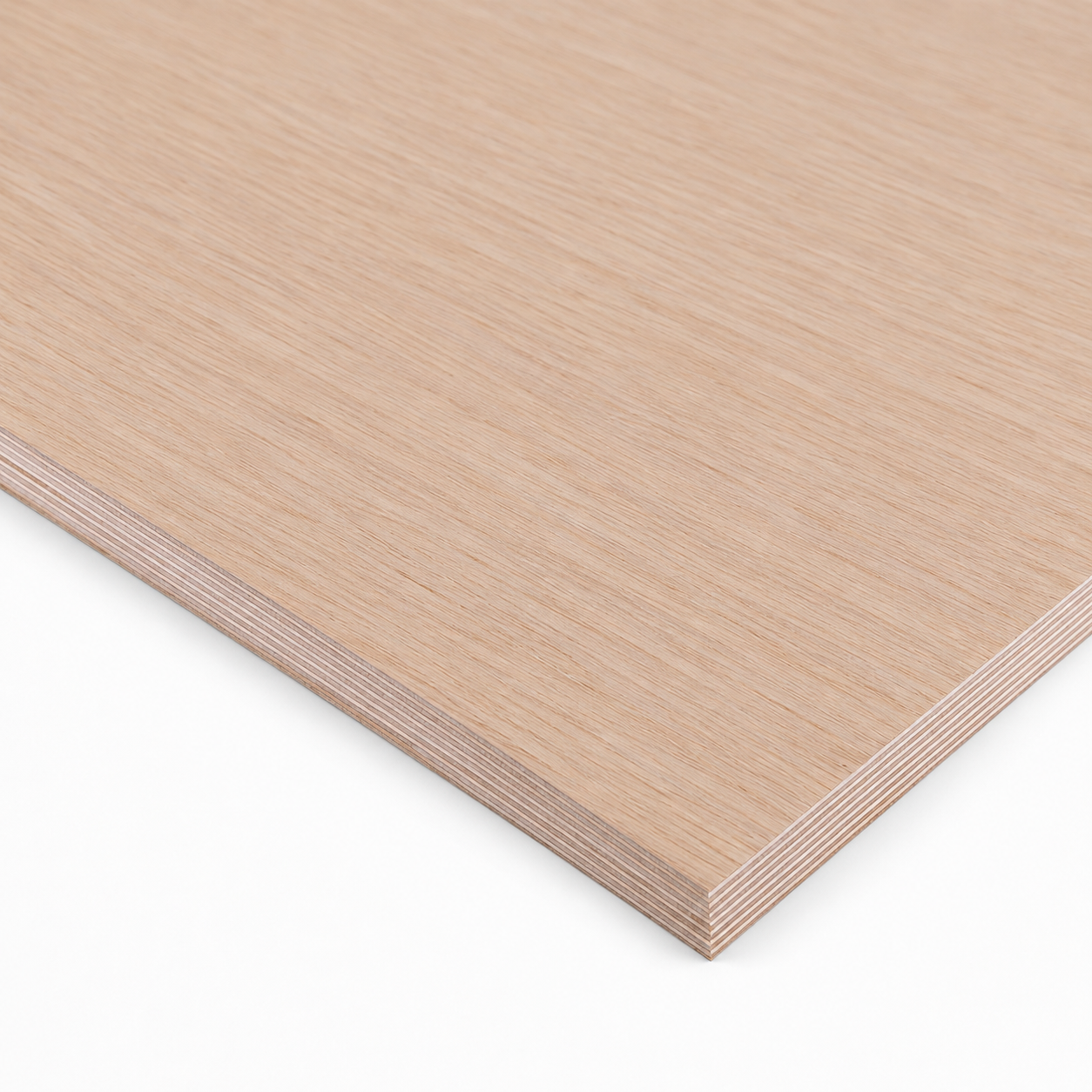
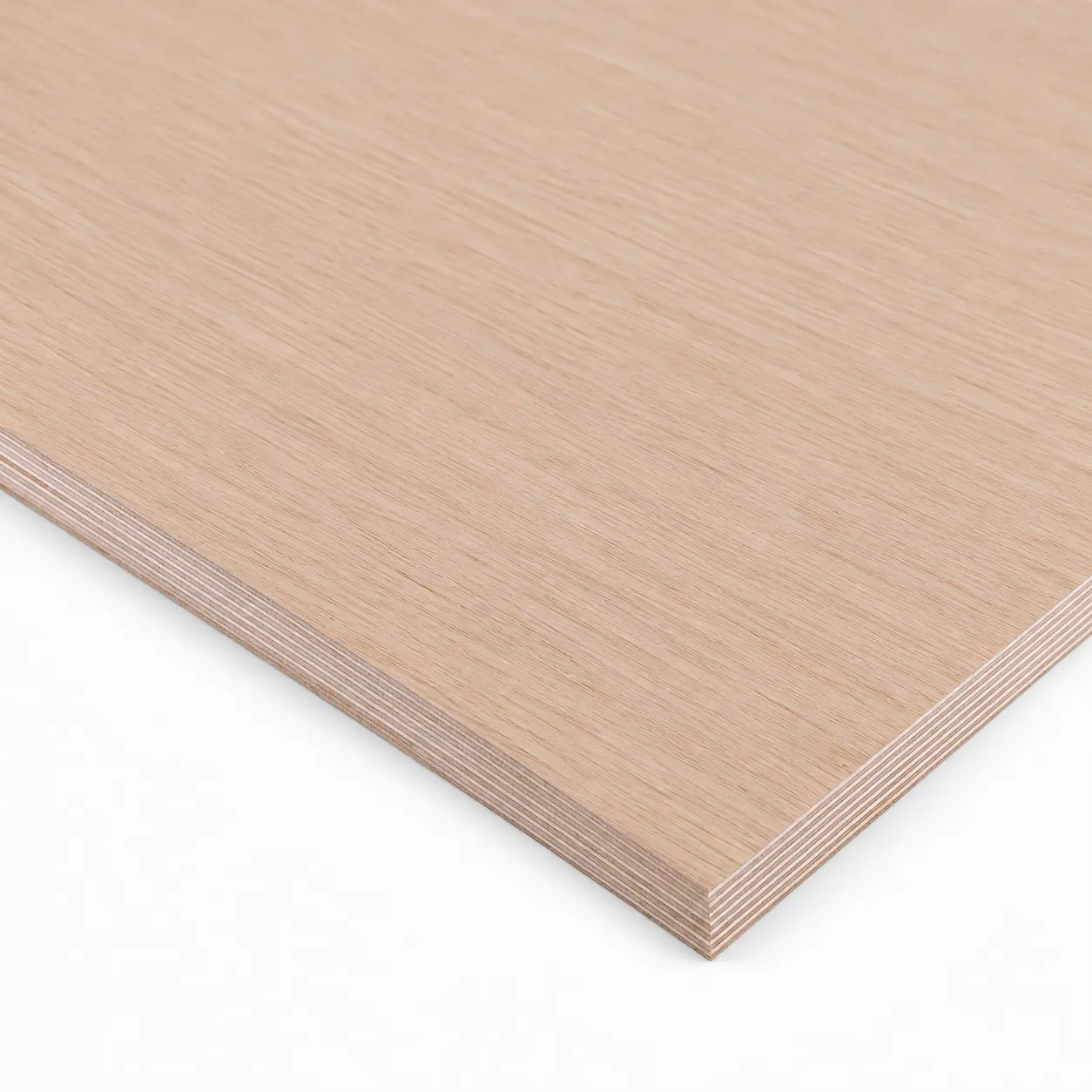
Oak veneered plywood gives you a real crown cut oak surface on a birch plywood core, which is how most oak furniture, kitchen doors and joinery are actually built. We carry it in 13 mm and 19 mm, A/B grade and veneered on both faces so it stays flat, in a generous 2500×1250 mm sheet, stocked in our warehouse and delivered across Ireland.
Sort by
Showing 1-2 of 2 results
What oak veneered plywood is
A thin layer of real timber, in this case oak, glued to the face of a plywood board. It is not a printed finish and it is not a laminate. The surface is genuine oak, so it sands, stains and finishes exactly as solid oak does, and once a door is hung nobody can tell the difference by looking at it.
Both of our boards are veneered on both faces, which matters more than people expect. A board veneered on one side only will bow, because the two faces take up and give off moisture at different rates and the panel ends up pulling itself into a curve. Veneering both sides balances it and keeps it flat, and on a tall cabinet door that is the difference between a door that shuts and one that catches at the top corner.
The core underneath is birch plywood, which is the part that makes these boards worth buying. You get an oak surface sitting on a dense, flat, void free board that holds a screw properly, rather than on a soft core that crumbles when you drive a fixing into the edge.
Crown cut and A/B grade
Crown cut describes how the veneer was sliced from the log. It produces the wide looping cathedral grain most people picture when they think of oak, rather than the straight narrow stripe you get from quarter sawn timber. If someone has asked you for real oak without saying more than that, crown cut is almost certainly what they have in mind.
A/B describes the two faces. The A face is the better one, with even colour and matched grain, and it is the side you show. The B face is sound and perfectly usable but less consistent in colour and figure, and it is the side that goes to the back of a panel or the inside of a cabinet. Mark which way round each piece goes before you start cutting, because it is easy to lose track once a sheet is broken down and a B face on a door front is not something you can undo.
Oak veneered plywood sizes
Both boards come in a 2500×1250 mm sheet, larger than a standard 8×4, which is a real advantage on tall work: a full height door and a shelf come out of one board where a standard sheet would leave you just short, and the extra 30 mm of width closes a panelling run in fewer pieces. Choose the thickness by the job:
- 13 mm (31.35 kg a sheet): doors and lighter panels. A door in 13 mm is noticeably lighter than the same door in 19 mm, so the hinges work less hard and a full height door is easier to hang and keep true. It also suits wall panelling, shelving on decent supports and the sides and fronts of built in furniture.
- 19 mm (45.83 kg a sheet): the cabinet itself. A concealed hinge seats with material behind it, assembly screws reach full depth into the edge, and shelf pin holes leave timber either side. It is also the thickness for desk and table tops, worktops and deep shelving, and a firm two person lift.
What people use it for
Oak kitchen and wardrobe doors are the most common job by a distance, followed by cabinet fronts and the units behind them. Shelving, wall panelling, desks and table tops, window seats and built in benches make up most of the rest. It goes wherever someone wants oak and does not want to pay for solid oak or deal with how much a solid oak panel moves across its width through a heating season.
It is also the usual choice for anything wide. A solid oak panel a metre across is expensive, heavy and never entirely settled, whereas a veneered board that width is stable, flat and costs a fraction of it.
Working with it
The veneer is thin, so the face is the thing to protect. Keep it upwards when cutting on a plunge saw or a table saw, score the line first, and never drag a sheet across anything, because a scratch through an oak veneer cannot be sanded out and the only repair is a patch.
Sand lightly and stop sooner than you think you should. Going through a veneer on an edge or a corner takes a couple of seconds with an orbital sander and there is no recovering from it. Light passes, and keep the machine moving.
The edges will show the plywood layers, so decide early what you are doing about them. Iron on oak edging tape is the usual answer, and it is worth buying tape from one batch and checking it against your sheet for colour before you commit to a whole kitchen. On the 19 mm board a solid oak lipping looks right and gives you an edge you can round over, which the tape will not.
Finishing it
Finish it as you would solid oak. Hardwax oil gives a warm tone and is easy to repair later, a water based lacquer keeps the board pale and is harder wearing. Do a test piece on an offcut first, because oak varies from board to board and the same finish reads differently on two sheets from the same pack.
Finish both faces of anything that is not fixed flat to something. A door oiled on one side only will start to move for the same reason a board veneered on one side bows, and it is far easier to do both faces at the bench than to take the door off again in six months.
How much does oak plywood cost?
Oak veneered plywood gives you a real oak surface for a fraction of what solid oak panels would take, on a birch core that stays flat and holds a screw. Price follows thickness, and the larger 2500×1250 mm sheet carries more board than an 8×4, so compare by the pieces you can cut from a sheet rather than the sheet alone. Enter your door and panel sizes into the calculator on the product page to see how many sheets you need, and the cart adds the matching extras automatically.
Oak veneered plywood vs veneered MDF and birch plywood
Oak veneered plywood and veneered MDF both give a real timber face; the plywood core is lighter for its strength and holds a screw in its edge, while the MDF core gives the flattest possible face for painted frames and panelling. For a whole wall of oak where the grain must never repeat, Querkus MDF is laid up to read as solid boards. If you want the same birch core without the oak face, birch plywood is the board.
Oak veneered plywood in Dublin and across Ireland
Both thicknesses are stocked in our Dublin warehouse, for collection or delivery across Ireland. Use the calculator on the product page to work out how many sheets a kitchen or a run of panelling needs, remembering that the larger 2500×1250 mm sheet often yields an extra door. The rest of the grades, and how they compare, are on the main plywood page.
Frequently Asked Questions About Oak Veneered Plywood
Is oak veneered plywood real oak?
Yes. The face is a thin layer of genuine crown cut oak, not a print or laminate, on a birch plywood core. It sands, stains and finishes exactly as solid oak does, and both faces are veneered so the panel stays flat.
What size is oak veneered plywood?
Both thicknesses come in a 2500×1250 mm sheet, larger than a standard 8×4, so a full height door or a wide panel run often comes out of fewer pieces. A 13 mm sheet weighs 31.35 kg and a 19 mm sheet 45.83 kg.
Should I use 13 mm or 19 mm oak plywood?
13 mm makes lighter doors and suits panelling and shelving on decent supports. 19 mm is what you build the cabinet itself from, because concealed hinges, assembly screws and shelf pins are designed around that depth.
How do I finish the edges of oak veneered plywood?
The cut edges show the plywood layers. Iron on oak edging tape is the usual answer, bought from one batch and checked against your sheet for colour. On the 19 mm board a solid oak lipping gives an edge you can round over.
What is the best finish for oak veneered plywood?
Hardwax oil gives a warm tone and is easy to repair; water based lacquer keeps the oak paler and wears harder. Test on an offcut first, and finish both faces of anything not fixed flat so it does not move.