
Length
Width
Thickness
Colour Tone
Profile
Material
Fire Rating
Range
Species
Wood Type
Warranty
Moisture Content
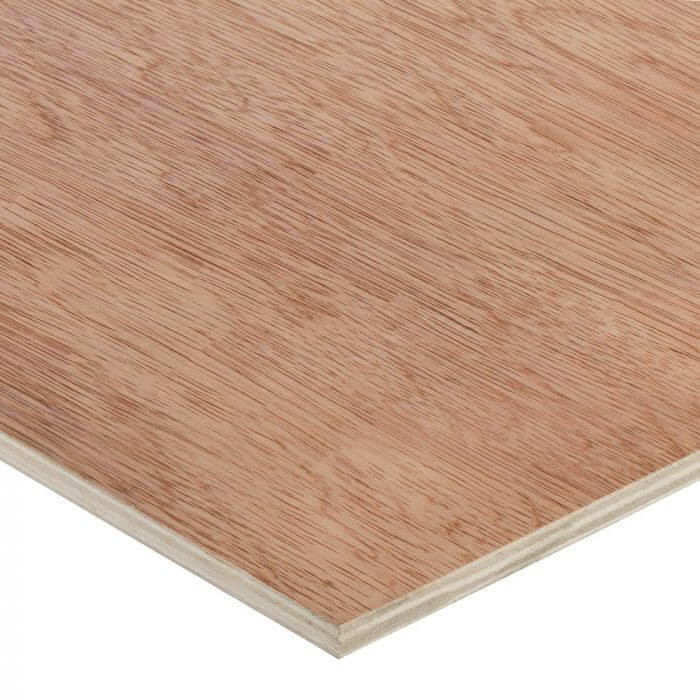
Hardwood Faced Plywood
Hardwood faced plywood is the everyday board for general construction, and the one most people reach for when the plywood will be painted or covered. It has a light poplar core with a hardwood veneer on each face, bonded to Class 2 for humid conditions, which keeps the price and weight down while giving a smooth surface to finish. We carry 5.5 to 25 mm in 2440×1220 mm sheets, stocked in our warehouse and delivered across Ireland.
Sort by
Showing 1-5 of 5 results
What hardwood faced plywood is
The name describes the construction. The middle of the board is poplar, a light, soft and inexpensive timber. The outer layer on each face is a hardwood veneer, which is harder, smoother and much better to paint or finish than poplar would be on its own.
That combination is the whole point. You get a smooth, paintable surface at a considerably lower price than a board made from hardwood the whole way through, and a sheet that is lighter to carry up a ladder or into a loft. The soft core grips a screw less firmly than an all hardwood board, so fix through the face where you can and the board will hold its own.
What Class 2 means
The boards are bonded to Class 2, which covers humid conditions rather than wet ones. In plain terms: an unheated garage, a shed, a utility room or a bathroom with decent ventilation is fine. Rain, ground contact and permanently wet areas are not.
In a bathroom, that means keeping it off the floor, away from direct splashing and properly sealed on every face. In a shed or garage it means keeping it clear of the ground and off an uninsulated outside wall, where condensation collects.
If the board is going outside or somewhere that gets properly wet, choose marine plywood, which is bonded to stay together when soaked. For everything short of that, sealed Class 2 hardwood faced plywood is the everyday choice.
What people use it for
Hardwood faced plywood is the general purpose board for jobs that will be painted, covered or tucked out of sight. The regular uses are:
- Garage and shed fit outs: shelving, workbench tops, tool boards and boxing in.
- Lofts: loft boarding over joists and storage platforms.
- Boxing in: pipework, boilers, and backing boards behind a TV or a radiator.
- Bathrooms: painted panelling and bath panels in a ventilated room.
- Renovation work: hoardings and protective floor covering while the job is under way.
It is also the usual board for the hidden parts of a job: the back and base of a built in wardrobe, packers and battens behind a fitted unit, and the substrate under a tiled or laminated surface.
Hardwood plywood thicknesses
Every sheet is 2440×1220 mm, the standard 8×4, so the choice is thickness. Pick it by what the board has to carry:
- 5.5 mm (8.7 kg a sheet): a lining and backing board that covers a surface and takes paint, easy to handle on your own.
- 9 mm: panelling, boxing in and light backing boards fixed to a frame. It is the first thickness that stays flat between battens rather than dishing between them.
- 12 mm: the general purpose thickness most people want, for shelving, shed and garage linings and loft boarding over joists.
- 18 mm (28.4 kg a sheet): anything carrying real weight, such as workbench tops, storage platforms, longer shelf spans and structural work that will be covered over.
- 25 mm (37.9 kg a sheet): the heavy option for a workbench top, a base under a machine or a shelf with nothing underneath it. It is a two person lift, and a full sheet will not go in most cars.
How much does hardwood faced plywood cost?
Hardwood faced plywood is the value board in our plywood range, because the light poplar core keeps both the price and the weight down. Price rises with thickness, since every step up adds layers, so the easiest saving is choosing the thickness the job needs rather than one step up. Every sheet is the same 2440×1220 mm size, so comparing per sheet and per square metre gives the same answer. Enter your area in the calculator on the product page to see how many sheets you need, and the cart adds the matching extras automatically.
Hardwood faced plywood vs birch and other plywood
The two boards look similar stacked on a shelf and behave very differently in use.
Birch is solid hardwood all the way through. It is stronger, holds screws far better, is much less likely to have voids in the core, and has an edge attractive enough to leave on show. It is also dearer and heavier.
The weight difference is worth knowing if you are boarding a loft. An 18 mm sheet here is 28.4 kg against 36.4 kg for birch the same size, and eight kilos a sheet adds up by the time you have passed a dozen of them up a loft ladder.
Hardwood faced plywood is cheaper and lighter, and perfectly good for anything that will be painted, covered or hidden. If the face or the edge is going to be seen and admired, or if the board is being screwed into repeatedly, spend the extra on birch. If it is going behind a wall, under a worktop or inside a garage, this is the sensible board. Where you want a hardwood core as well as a hardwood face, Malaysian hardwood plywood sits between the two, and for rough structural work that will never be seen, softwood plywood is the other option.
Working with it
The face veneer is thin, so it chips along the cut if you rush. Use a blade with plenty of teeth, keep the good face upwards, and score the line with a knife where the edge will be seen.
Expect the occasional small void in the core. Poplar core boards are not made to the same standard inside as birch, and when you cut one you may find a small gap in an inner layer. It is normal at this price and not a fault, but it matters in two places: do not rely on an edge screw landing in solid material, and fill the edge before you paint it.
Filling the edge is the difference between a painted job that looks made and one that looks temporary. A skim of fine filler, sanded flat when dry, then primed, will hide the layers completely.
Always pilot screws near an edge. Poplar splits more easily than birch, and it will not grip a screw driven into the edge the way a denser board does. Where possible, screw through the face rather than into the edge.
Painting it
The hardwood face takes paint well, but it needs sealing first or the grain will lift and show through the topcoat. A thinned coat of primer or a coat of shellac, sanded lightly once dry, then prime and paint as normal.
Do the edges before the faces, and fill them first as above. An unfilled edge soaks up primer unevenly and ends up a different sheen to everything around it, which is the detail that gives a painted plywood job away.
If the board is going somewhere humid, such as a bathroom or an unheated garage, paint the back as well as the front. Sealing one side only lets the board take up moisture unevenly, and that is what makes a panel bow.
Hardwood faced plywood in Dublin and across Ireland
The full range is stocked in our Dublin warehouse, for collection or delivery across Ireland. A 12 mm sheet is manageable for one person; 18 and 25 mm are two person lifts. Use the calculator on the product page to work out how many sheets a loft, a garage or a set of shelves needs.
Birch, marine, flexible and fire retardant boards, and how the grades compare, are all on the main plywood page.
Frequently Asked Questions About Hardwood Faced Plywood
What is hardwood faced plywood?
It has a light poplar core with a hardwood veneer on each face. The core keeps the price and weight down, while the hardwood faces give a surface smooth enough to paint. Our boards are B/BB grade, from 5.5 mm to 25 mm.
Where can I use Class 2 hardwood faced plywood?
Class 2 bonding covers humid conditions, not wet ones. An unheated garage, a shed or a ventilated bathroom is fine if the board is sealed, but rain, ground contact and permanently wet areas need marine plywood.
Is hardwood faced plywood good for loft boarding?
Yes, it is a common choice. 12 mm suits loft boarding over joists, and 18 mm takes storage platforms carrying more weight. An 18 mm sheet weighs 28.4 kg against 36.4 kg for birch, which adds up passing sheets up a loft ladder.
How do I paint hardwood faced plywood?
Seal the face first with a thinned coat of primer or shellac, sand lightly, then prime and paint. Fill the edges with fine filler before painting, and in a humid room paint the back as well so the board does not bow.
Is it normal to find gaps inside the board?
Yes, an occasional small void in an inner layer is normal for a poplar core board. Screw through the face rather than relying on an edge fixing, and fill the edge before painting.