
Length
Width
Thickness
Colour Tone
Profile
Material
Fire Rating
Range
Species
Wood Type
Warranty
Moisture Content
Querkus MDF
Querkus MDF is Decospan’s oak veneered panel range: a real oak face pressed onto an MDF core and laid up so the grain never repeats or mirrors the way ordinary veneer does. Use it where a wall, a run of doors or a set of joinery has to read as solid oak across the whole elevation. We carry Adagio and Allegro in 19 mm, 3050×1220 mm sheets, stocked in our warehouse and delivered across Ireland.
Sort by
Showing 1-2 of 2 results
What Querkus MDF is
Querkus is Decospan’s oak veneered panel range. The face is real oak, sliced into veneer and pressed onto an MDF core, and the reason to pay for it rather than a plain veneered board is control over how that face is laid up. The pieces of oak making up each sheet are selected and jointed to a set pattern, so a run of doors or a whole panelled elevation reads as one piece of work rather than a set of sheets that happen to be the same species.
On ordinary veneered MDF the face is whatever came off the log, book matched in pairs, and across a large installation that mirrored pattern repeats down the wall and gives the material away as a veneer. Decospan’s mixmatch lay up joints each face from boards of differing width and figure, so the grain never falls into a repeat and never mirrors. What you get on the wall reads like a floor or a run of solid oak boards, on a panel that stays flat and fits in a fraction of the time solid boards take.
Adagio and Allegro
We carry two characters from the Natura range, both 19 mm in a 3050×1220 mm sheet, and choosing between them is entirely about how busy you want the face to be.
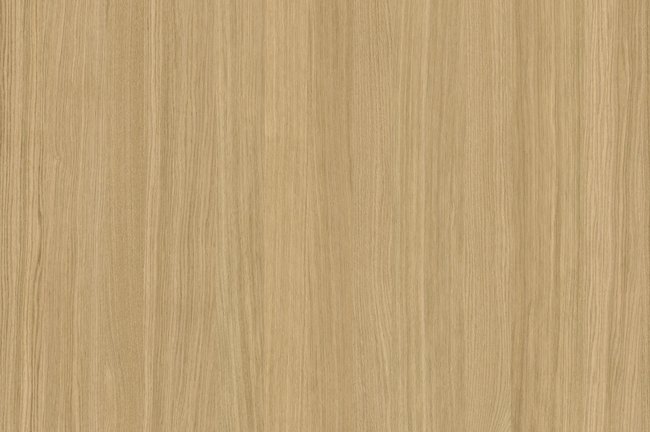
Adagio is the calm one. Each face is jointed from three wide crown cut boards, so the figure is broad and generous: crown cut gives the cathedral arches most people picture when they think of oak, with softer flowing grain either side. Across a tall panel it reads quiet and expensive, which suits large uninterrupted surfaces such as a run of full height wardrobe doors or a feature wall where you want the oak to be the finish rather than the pattern. The face is brushed, meaning the softer early wood has been worked back slightly so the harder grain stands proud, and the surface has a texture you can feel as well as see.
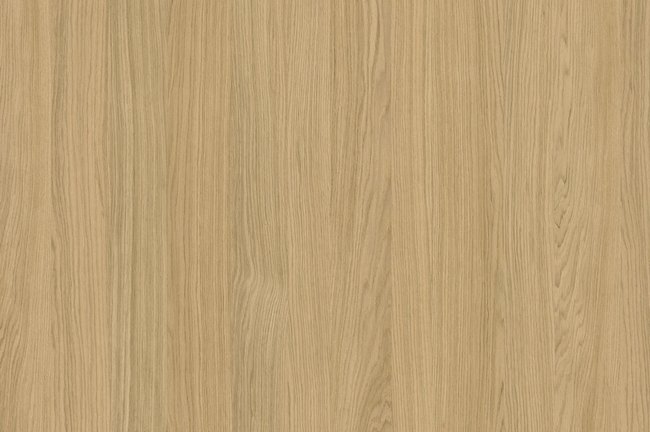
Allegro puts more and narrower boards across the same sheet, mixing quarter cut oak with crown cut. Quarter cut has tight, straight, linear grain with the occasional ray fleck, so set alongside the crown cut arches the face reads as a run of narrow planks. It is busier than Adagio and spread more evenly, with no single arch dominating the middle of a panel. On a tall elevation it carries the eye further, and it disguises the joints between sheets better, which matters once a wall is wider than a single 1220 mm board.
Both are pale, both are oak, and both take the same finishes. If you are matching an existing floor or an existing run of joinery, order a single sheet first and hold it against the thing you are matching before you commit to the rest, because oak varies and a photograph will not tell you.
Querkus Panel Size
Adagio and Allegro come in the same board, 19 mm thick in a 3050×1220 mm sheet, so the only choice you make is the look. The size does a lot of the work for you on tall walls and doors: the 3050 mm sheet, the old 10×4, covers a full height wall or wardrobe door in one piece with no joint across it, and the balanced construction below keeps it flat at that length.
How the panel is built
Under the face there are two layers of veneer pressed to an 18 mm MDF core, the second one acting as a balancer on the back. That is what keeps a sheet this long flat. Veneer pulls as it dries and as the humidity in a room changes, and a face with nothing on the other side to pull against will cup within a season. It also means the back of the sheet is a usable surface in its own right on a door or a shelf that is seen from both sides.
The core is standard MDF, so everything you already know about machining MDF applies. It routs to a crisp edge, it holds a straight line, and it has no voids to turn up in a cut. Like every standard MDF core it is made for dry interiors, and that is what decides where the board goes.
Cutting, finishing and edging
A 3050×1220 mm sheet is long and heavy and needs two people and a route planned before it arrives. Work out where it is going to be set down beforehand, because there is nowhere to get a hand under a sheet this size once it is flat on the floor.
The veneer is thin, and everything about handling it follows from that. Keep the good face upwards on a table saw or under a plunge saw, score the cut line first, and never drag a sheet across anything, including another sheet. A scratch through an oak veneer cannot be sanded out, and a corner sanded through to the MDF underneath cannot be repaired at all.
Sand lightly and stop sooner than you think you should. Finish it as you would solid oak, with oil, hardwax or lacquer, and test on an offcut first, because oak varies from sheet to sheet and the same oil reads differently on two boards. The brushed face takes an oil particularly well, since the finish settles into the open grain rather than sitting on top of it. On Allegro, check the finish across a joint as well as along a board, because the narrow plank face puts far more joints in front of you.
Edge it with an oak edge banding, or lip it in solid oak where the edge is going to take wear. A door edge or a shelf front is worth a solid lipping. A concealed edge is not.
Querkus MDF compared with other boards
Querkus is an interior panel on a standard MDF core, made for living rooms, bedrooms, offices and shopfits. For a timber look in a kitchen, bathroom or utility room, moisture resistant MDF takes the damp and can be painted or lipped, and Tricoya MDF is the board for wet and exterior work. Like any oak, the face mellows and warms in strong sunlight, so let panels on one wall see the same light rather than leaving half of one behind a curtain.
Compared with veneered MDF, which is book matched straight off the log, Querkus is selected and jointed to a set pattern. On a single cabinet the difference is small; on a full wall or a run of wardrobe doors it is the difference between a veneer and something that reads as solid oak. If you want colour through the board rather than grain, coloured MDF is the alternative. For shelving that carries real weight, fix into a frame, and pilot any screw into the edge with a coarse threaded screw, as with any MDF core.
Querkus MDF in Dublin and across Ireland
We stock Querkus Adagio and Querkus Allegro in our Dublin warehouse, both 19 mm in the 3050×1220 mm sheet, for collection or delivery across Ireland. Order everything a job needs in one go where you can, because veneered panels are matched in batches and two orders months apart will not necessarily look the same on the same wall. Use the calculator on the product page to work out how many sheets a wall or a run of doors needs. Plain, coloured, moisture resistant and fire retardant boards are all on the main MDF boards page.
Frequently Asked Questions About Querkus MDF
What is Querkus MDF?
Querkus is Decospan’s oak veneered panel range: a real oak face on an MDF core, jointed from boards of differing width and figure so the grain never repeats or mirrors. A run of doors or a panelled wall reads like solid oak.
What is the difference between Adagio and Allegro?
Adagio is the calm one, each face jointed from three wide crown cut boards. Allegro mixes narrower quarter cut and crown cut oak, so it reads as a run of narrow planks and hides the joints between sheets better. Both have a brushed face.
What size are Querkus panels?
Both Adagio and Allegro come in 19 mm, in a 3050×1220 mm sheet, built from two layers of veneer on an 18 mm MDF core. The long sheet needs two people to carry.
How do I finish Querkus oak?
Finish it as you would solid oak, with oil, hardwax or lacquer, testing on an offcut first. The brushed face takes oil particularly well. Sand lightly, because the veneer is thin and a corner sanded through cannot be repaired.
Will panels from two orders match?
Not necessarily. Veneered panels are matched in batches, and two orders months apart may not look the same on one wall, so order everything a job needs in one go.