
Length
Width
Thickness
Colour Tone
Profile
Material
Fire Rating
Range
Species
Wood Type
Warranty
Moisture Content
Veneered MDF Sheets
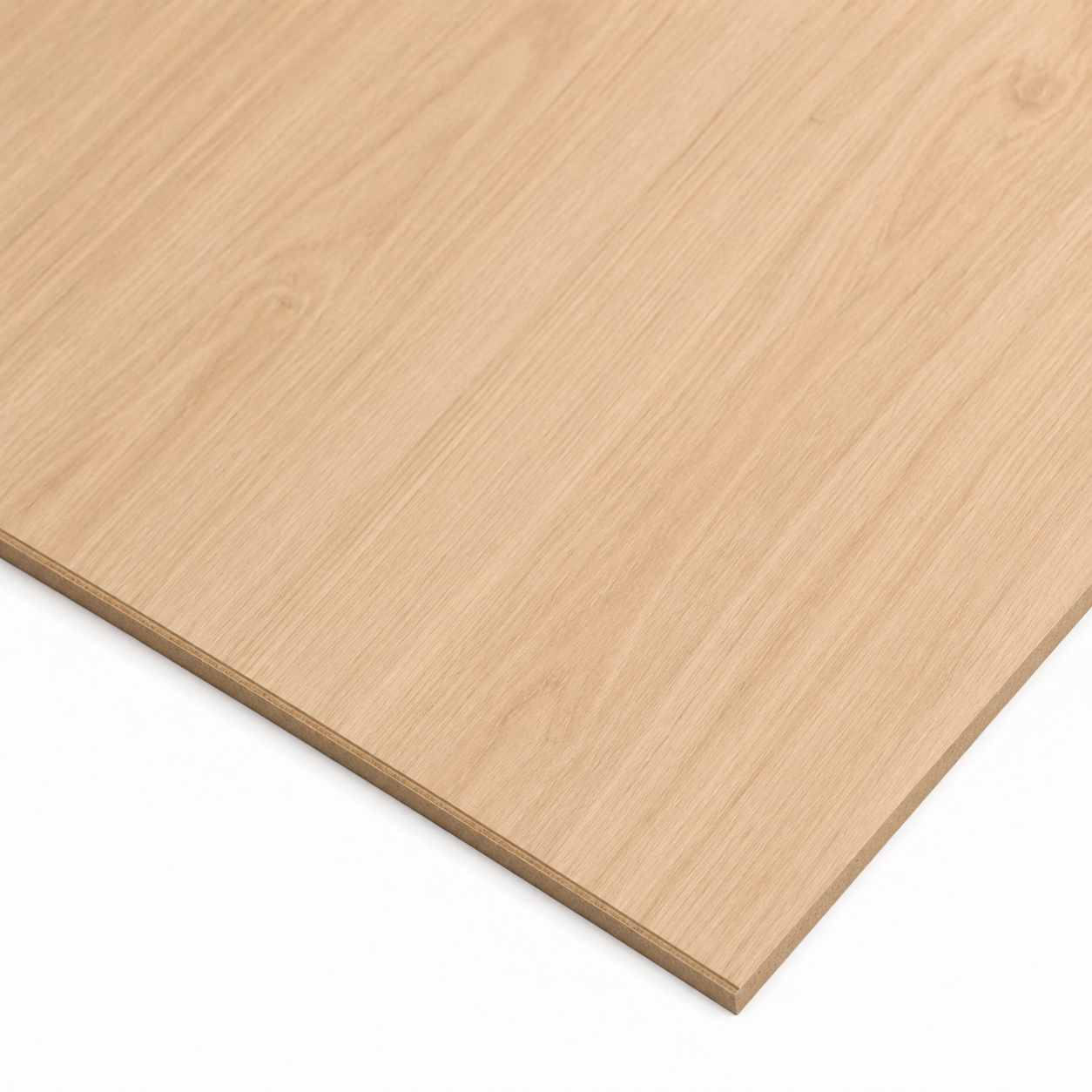
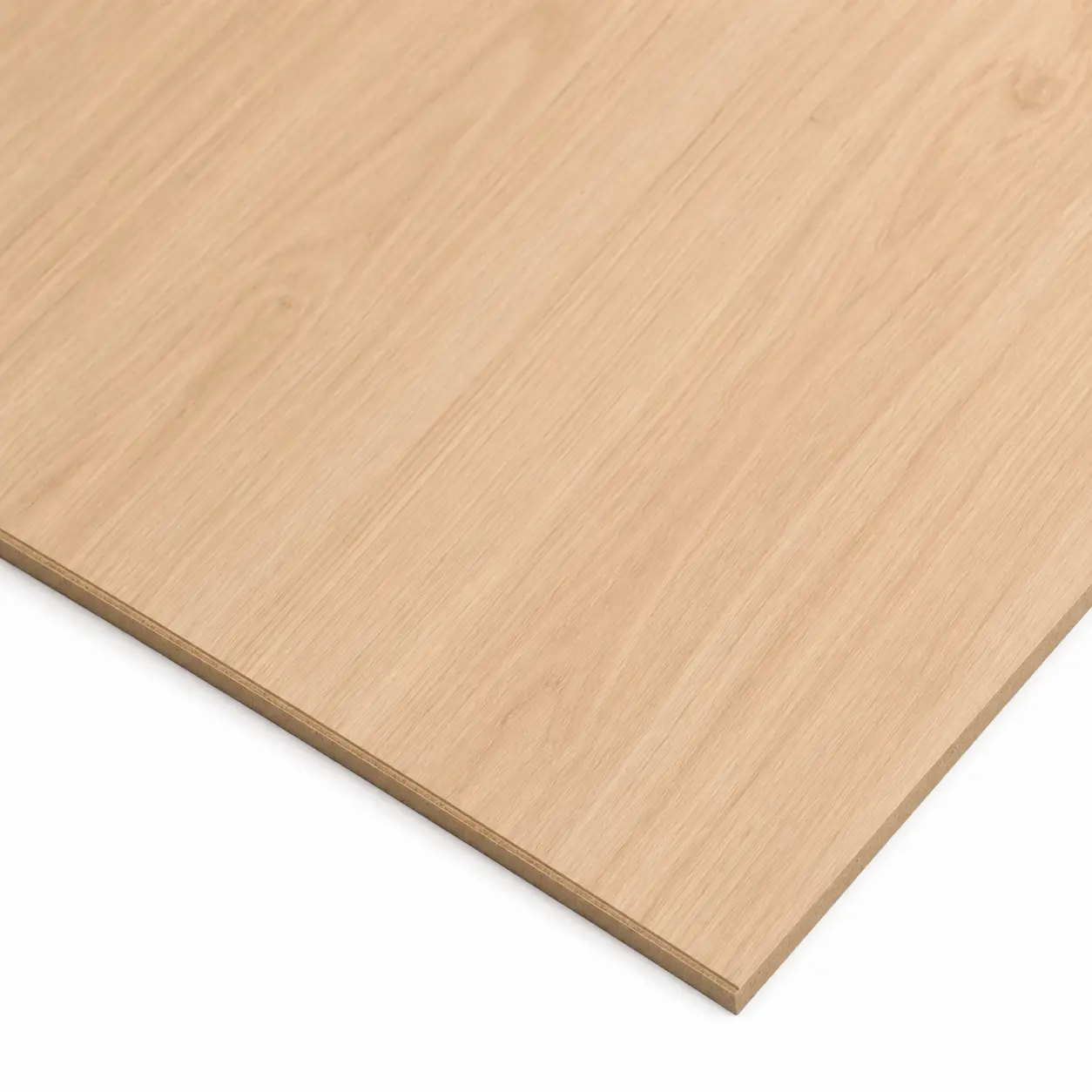
Veneered MDF is a real timber face on a flat, stable board, so you get the look of solid oak or walnut on a panel that will not cup or move across its width. We carry six species, all crown cut and A/B grade. White oak runs the full ladder from 4 mm to 39 mm, with 19 mm the thickness most joinery is built from, and ash, walnut, cherry, maple and mahogany are held at 19 mm. Sheets come 2440 x 1220 mm and 3050 x 1220 mm, including a fire rated white oak board. Delivered across Ireland from North Dublin.
Sort by
Showing 1-12 of 17 results
What veneered MDF actually is
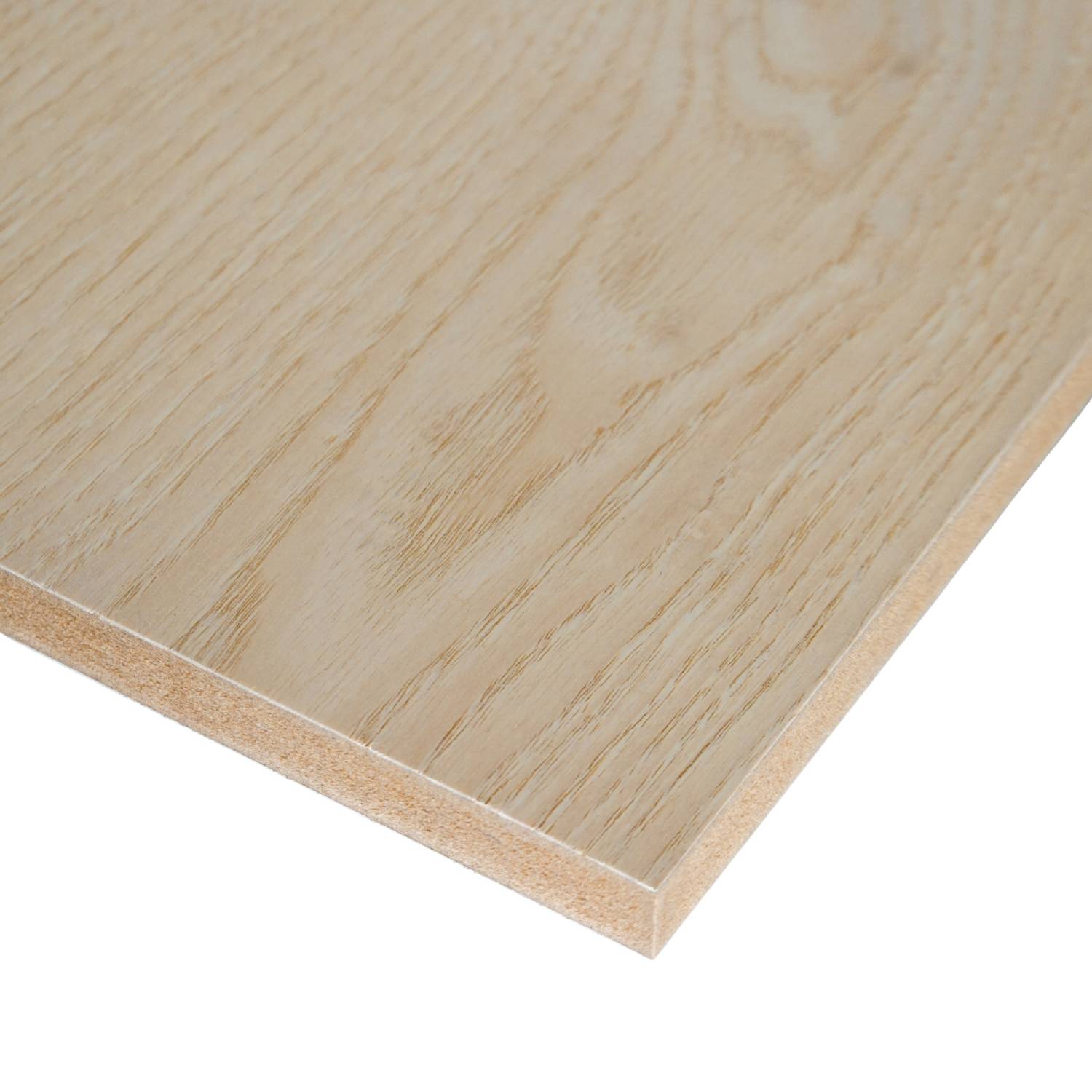
Veneered MDF is a slice of real timber glued to a fibreboard core. The face is genuine oak, ash, walnut, cherry, maple or mahogany, usually well under a millimetre thick, and it sands, stains, oils and lacquers exactly as the solid species does. What sits underneath is the point: a board that stays flat, holds its width, and comes in sheets far wider than any plank.
Every board here is veneered on both faces, and the second face is not decoration. It balances the pull of the glue and the finish on the show side, and without it a wide panel would curl towards the veneered face as it dried. That is also why you finish both sides of a panel even when only one will ever be seen.
The veneer is crown cut and graded A/B. Crown cut means the log was sliced tangentially, which is what produces the broad arched figure most people picture when they think of oak or walnut. A/B means one face is selected for clear finishing and the back is sound but plainer, which is the grade specified for visible joinery.
Choosing a thickness
Most oak faced joinery is built from 19 mm. It is substantial enough to hang a door on, take drawer runners and hold cabinet hardware without any special detailing, and if a drawing does not state a thickness this is the one it assumes. Below that, 16 mm buys back three millimetres on each side of a unit, which matters more than it sounds when it decides whether a drawer box fits, and 12 mm is where most panelling, cabinet backs and light shelving sit.
Thinner again and the board stops carrying anything. 7 mm is the panelling and door skin thickness, stiff enough to stay flat over a light frame without deepening the detail, while 4 mm will bend to a gentle curve around a former straight off the sheet, which is how curved cabinet ends and bath panels get an oak face. Neither will hold a screw in its edge, so both are fixed through the face or bonded to a substrate.
Going the other way, 26 mm is the point where the board stops being something you build a box from and becomes the piece itself: reception counters, desk tops, bar fronts and heavy library shelving, with an edge deep enough to lip in solid oak and then shape. 39 mm is a slab, ordered when the depth of the piece is part of the design, usually one or two components in a scheme rather than a whole fit out.
Sheet sizes
Standard is 2440 x 1220 mm. The 3050 x 1220 mm sheet exists for one reason: a cross joint in an oak face cannot be hidden, because the grain will not run through it and no filler or lipping makes it disappear. On a full height wardrobe front or a floor to ceiling panelled wall, the long sheet keeps that joint out of the middle of the show face. It is a three metre two person lift, so measure the route into the building before it arrives.
The species
White oak is the default and the only one we hold across every thickness. It is pale golden brown with a straight, open grain, and it takes hardwax oil or clear lacquer without argument.
Ash is the pale one with the loud grain, close to white with strong sweeping figure, and it lifts a dark room in a way oak does not. Maple sits at the other end of the same range, cream to pale tan, fine and almost featureless, and it gets chosen when the joinery is meant to disappear behind whatever is in front of it. A plain pale face hides nothing, so a dent or a proud joint that oak would swallow shows plainly on maple and the work has to be tidier for it.
Walnut is the dark one and the expensive one, deep chocolate with purple and grey running through it, and it lightens with exposure rather than darkening, which catches people out when they match new work to an old piece. Cherry does the opposite and does it faster, arriving pale pinkish tan and ripening to a deep warm red within months, and anything left shaded stays pale, so panels for one job need to come from one batch and be exposed together from the start. Mahogany is the traditional one, warm red brown with a quiet straight grain, and it is the easiest of the six to match into existing period joinery.
Veneer is a natural product and colour varies between production runs. If a job needs several sheets to read as one surface, order them together and keep them in sequence. Coming back for one more sheet in six months rarely gives a match.
Fire rated boards
Where a reaction to fire class forms part of the specification, there is a fire rated white oak board at 19 mm in the 3050 x 1220 mm sheet. It answers a problem that comes up constantly in hotels, schools, hospitals and escape routes, where the designer wants a timber face and the building consent wants a classification.
Two things are worth checking before you order it. Reaction to fire is not the same as fire resistance, so read which one the specification is actually asking for. The classification also belongs to the whole build up rather than to the panel alone, so a heavy coating or a bonded laminate applied on site can take the assembly out of class even though the board itself is rated. The rest of the rated range is on the fire retardant MDF page.
Cutting, edging and finishing
Veneer chips if the blade is dull or the feed is wrong. Score the face along the line before the main pass, use a sharp fine tooth blade, and keep the good face upwards on a table saw or downwards on a plunge saw. Support the sheet along the whole cut rather than at its ends, because a panel that flexes across the line tears out underneath.
Every cut exposes the core, so every exposed edge has to be covered. Iron on edging in a matching species is the quick answer and is fine anywhere concealed. A solid timber lipping is the better one wherever the edge is seen or handled, because it can be radiused, knocked and refinished. Fit the lipping before final sanding so the lipping and the face come flush and the joint disappears.
Sand to 180 or 240 grit and stop there. The veneer is thinner than people expect and an orbital sander goes through a corner in seconds, with no way back once you are into the core. Test the finish on an offcut before it goes near the job: cherry and walnut both look considerably darker under oil than they do dry, ash takes stain unevenly through its open pores, and most oils carry enough amber to push maple towards yellow.
Where not to use it
The core is MDF, so these are dry interior boards. Keep them out of bathrooms, utility rooms and anywhere that gets wet, because a veneered face does nothing to stop a fibreboard core swelling. None of them is structural, and thickness does not change that: a shelf will deflect over a long span even at 19 mm, so lip the front edge or add a bearer past about 800 mm.
If the face is going to be painted there is no reason to pay for timber underneath it, and standard MDF is the board for that. For a real timber face on a plywood core instead, there is veneered plywood. Everything else we carry, including the moisture resistant and fire retardant boards, is set out on the MDF page.
Buying veneered MDF
We are a sheet materials supplier in North Dublin, delivering nationwide, with boards held for collection or delivery. Because figure varies from sheet to sheet, call before you order if a job depends on a close match across several boards, or if you need a species or thickness that is not listed here. Ask about cutting to size at the same time, which on the long sheets is often the difference between a manageable panel and one that will not go up a stairwell.