
Length
Width
Thickness
Colour Tone
Profile
Material
Fire Rating
Range
Species
Wood Type
Warranty
Moisture Content
Composite Decking
Composite decking is a low-maintenance deck board made from wood fibre blended with plastic, for garden decks and terraces where you want the look of timber without the yearly oiling. We stock five ranges built three ways, from our entry PuraPro up to the solid Puraboard: hollow boards 135 to 145 mm wide, a capped board in a choice of lengths, and a solid board 175 mm wide. Stocked in our warehouse and delivered across Ireland.
Sort by


Showing 1-12 of 30 results
Composite Decking in Ireland
Composite decking is a deck board made from wood fibre blended with plastic, with a timber grain on its face. You get the look of a wooden deck without the yearly routine: no oiling, no staining and no sanding over the life of the deck. Hidden clips or concealed screws hold the boards down, so the surface is free of visible fixings, and the textured faces give you grip on a deck that stays wet for much of the Irish year.
Composite is the wrong choice if you want real wood that you can sand back and re-oil. It also needs a joist frame at 350 mm centres or closer, which is the distance from the middle of one joist to the middle of the next. If you plan to reuse an old frame built with wider spacing, it will need extra joists first.
Our Five Composite Decking Ranges, From Entry to Top
We stock five composite decking boards, and each one has a clear place in the range. Start with where the deck is and how hard it will work, then pick the board that matches:
- PuraPro composite decking: a square hollow board, 135×25 mm, with a grooved face and a wood grain face. The best value per m² for back gardens and holiday lets.
- PuraPlus composite decking: the same construction on a wider 145×21 mm board, for fewer joints on a large terrace.
- PuraPrime composite decking: a reinforced round hollow board, 140×22 mm, stiffer underfoot, with a ribbed anti-slip reverse face.
- PuraShield composite decking: a co-extruded board capped all round against stains and fading, 138×22.5 mm, in a choice of three lengths.
- Puraboard solid composite decking: a solid 175×22 mm polyurethane board with no wood in it, an embossed grain and an R11 grip rating, screw fixed with no clips.
Each step up buys you something specific: width, stiffness, a protective cap, or a solid section. You never need the top board for a sound deck, but you will notice the difference on a deck that works hard. Manufacturer warranties differ by range too: PuraPro and PuraPlus carry 15 years for residential use and 10 years for commercial use, PuraPrime carries 15 years, and PuraShield carries 25 years for residential use and 15 years for commercial use.
Types of Composite Decking: Hollow, Capped or Solid
Composite decking boards are built in three different ways. The construction decides how much a board weighs, how it feels underfoot, how well the surface stands up to stains and sun, and what it costs, so choose it first and the colour second.
Hollow composite decking
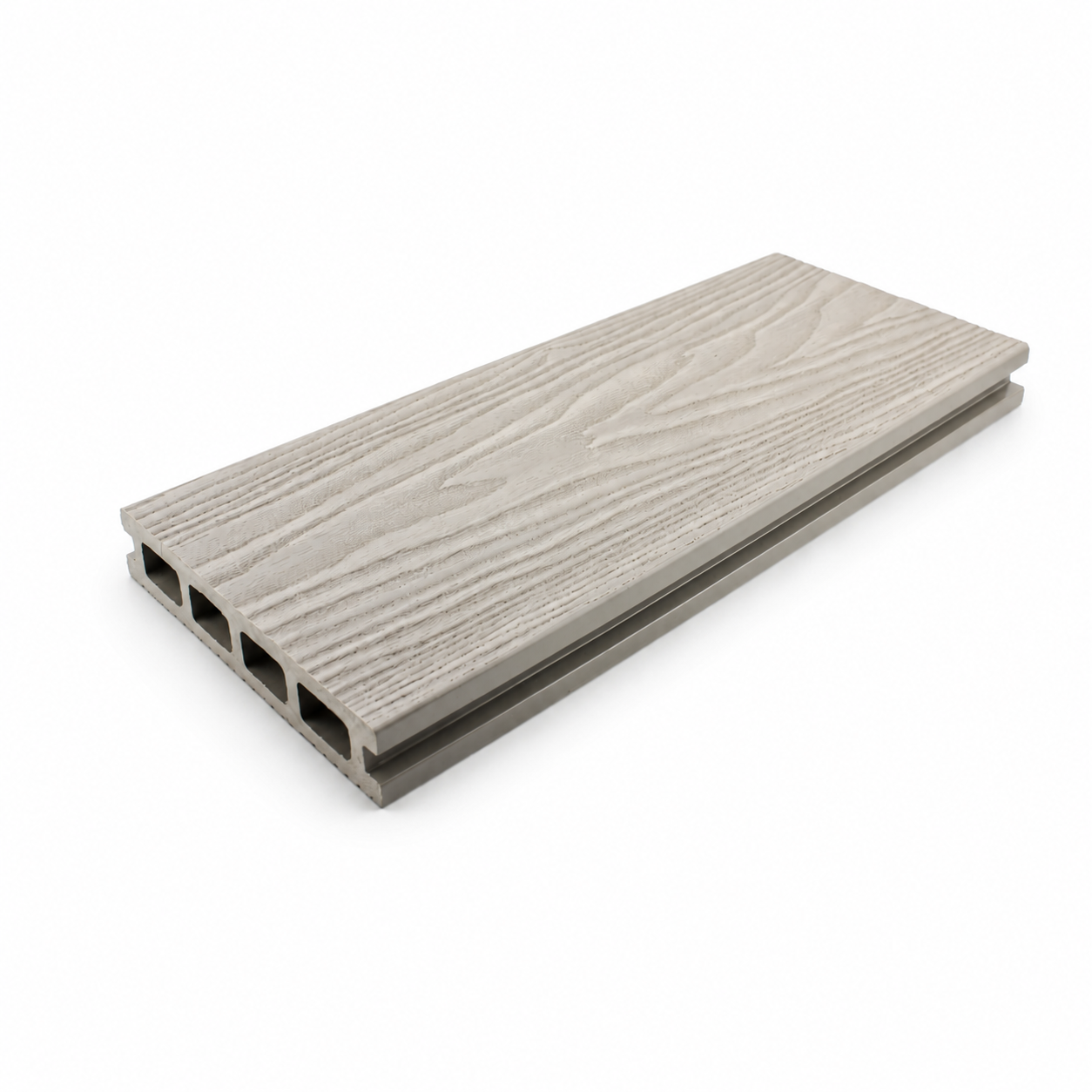
Hollow boards have chambers running the length of the core, which cut the weight and the cost without taking away the strength a deck board needs. PuraPro and PuraPlus have square chambers; PuraPrime has round, reinforced chambers that leave more material in the board, so it flexes less. All three share the same five colours and come in one board length, so you choose on colour. Where board ends meet on a long run, a double joist keeps the ends level. The open ends are finished with a matching trim, edge board or fascia, because the chambers can’t be screwed through.
Capped composite decking
Capped, or co-extruded, composite decking has two layers formed together in one pass: a structural wood and plastic core wrapped in a continuous polymer cap bonded to it under heat. The cap is part of the board, not a coating. Spills and leaf stains sit on the surface and lift off, and the colour, held in the cap, fades less. PuraShield is our capped board, with the cap running right round the board and inside its chambers.
Solid composite decking
Solid composite decking has no chambers: the board is one material all the way through, so it walks firm and quiet, with no hollow ring. Our solid board, Puraboard, is made of polyurethane with no wood in it, so there is nothing to rot or swell, and at 175×22 mm it is the widest board we stock. It is screw fixed rather than clipped, with PuraFix screws top fixed or side fixed so they all but disappear, and its cut ends can be shaped and left on show. The trade-off is cost, as it is the dearest board in our range.
Co-Extruded vs Mono-Extruded Composite Decking
Every composite board is extruded: the heated blend is pushed through a shaped die, like toothpaste from a tube. A mono-extruded board, such as PuraPro, PuraPlus or PuraPrime, is one blend all the way through, with the colour running through the whole board. It wears well and costs less, but its surface is more open to grease, leaf stains and sun. A co-extruded board adds the protective cap in the same pass. Choose mono-extruded for a sheltered garden deck where value matters; choose capped PuraShield for full sun, coastal sites, barbecue areas and decks under trees.
Which Is the Best Composite Decking?
The best composite decking in Ireland is the one that suits your site, not simply the dearest board. Match the board to the job:
- Best value for a back garden: PuraPro, the lowest cost per m² in our range.
- Best for a large terrace: PuraPlus, whose 145 mm width means fewer boards and joints.
- Best for grip and a firm feel: PuraPrime, with its stiffer round hollow core and ribbed anti-slip face.
- Best for sun, sea and barbecues: PuraShield, the capped board that resists stains and fading.
- Best for a solid, rot free board: Puraboard, solid polyurethane with no wood in it and an R11 grip rating.
Composite Decking Colours
There are 15 colours across the five ranges, from greys and blacks to wood tones. See the boards in daylight before you decide, because every finish carries some variation in tone and grain.
Grey and black composite decking
Grey composite decking suits modern houses, rendered walls and dark window frames, and black composite decking makes the deck a feature rather than a backdrop. Paler greys brighten a shaded deck and darker shades ground a bright, open garden, so pick the shade by the light:
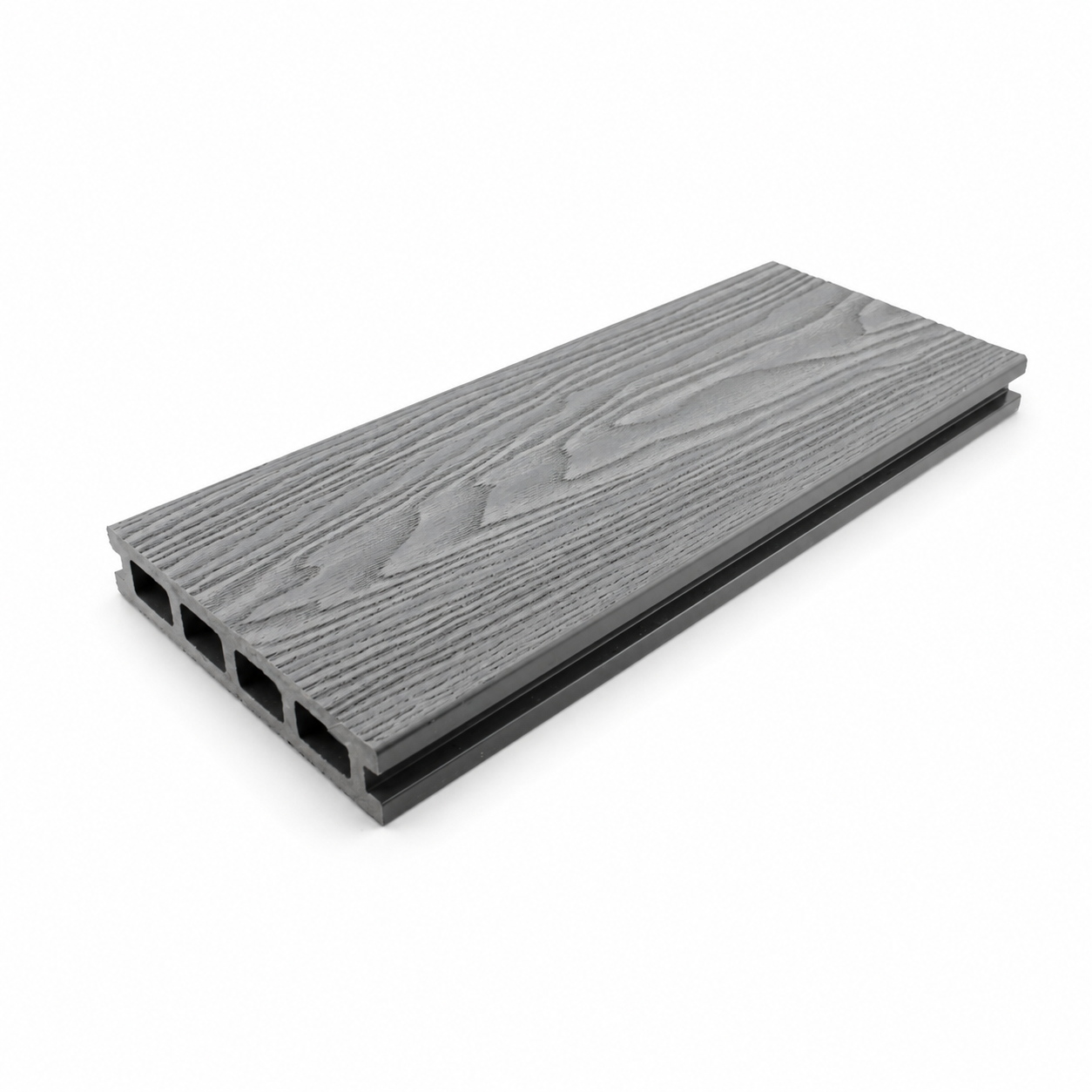
- Silver Ash (PuraPro, PuraPlus, PuraPrime): a pale, weathered grey like driftwood.
- Light Grey (PuraShield): a neutral pale grey that opens up a smaller deck.
- Cashmere (Puraboard): a soft light grey with a warm undertone.
- Slate Grey (PuraPro, PuraPlus, PuraPrime): a cool, slightly blue mid to dark grey.
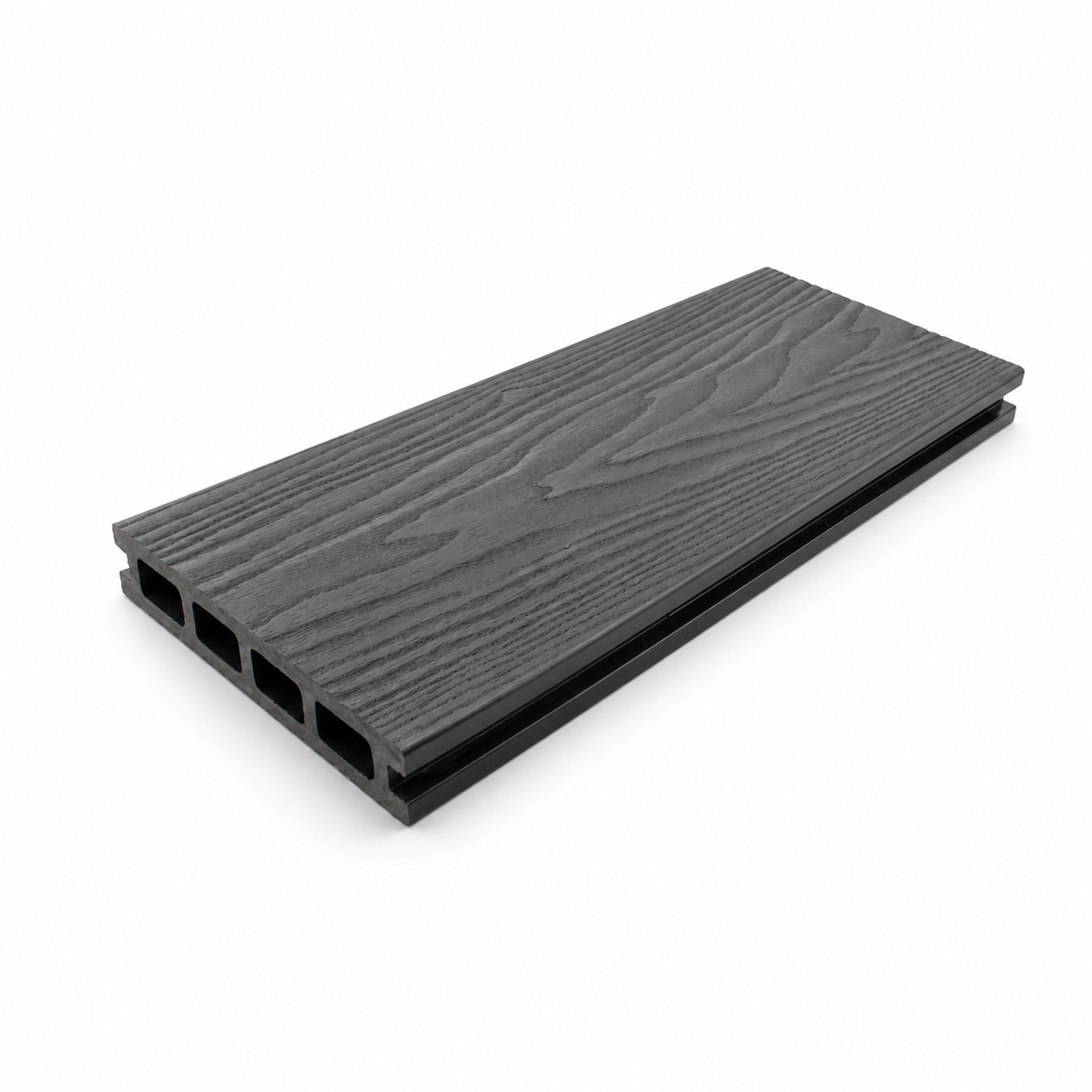
- Charcoal (PuraPro, PuraPlus, PuraPrime): a deep, even grey that stops short of black, as on PuraPlus Charcoal decking.
- Dark Grey (PuraShield): a deep anthracite that still reads as grey, not black.
- Ebony Black (PuraShield, Puraboard): a true deep black. On PuraShield the protective cap helps a dark board hold its colour in full sun, as on PuraShield Ebony Black decking.
Brown and wood-tone composite decking
If you want the look of a timber deck without the upkeep, choose a wood tone. They run from pale creams that stay bright on dull days to deep browns that pass for hardwood, so match them to your paving and walls:
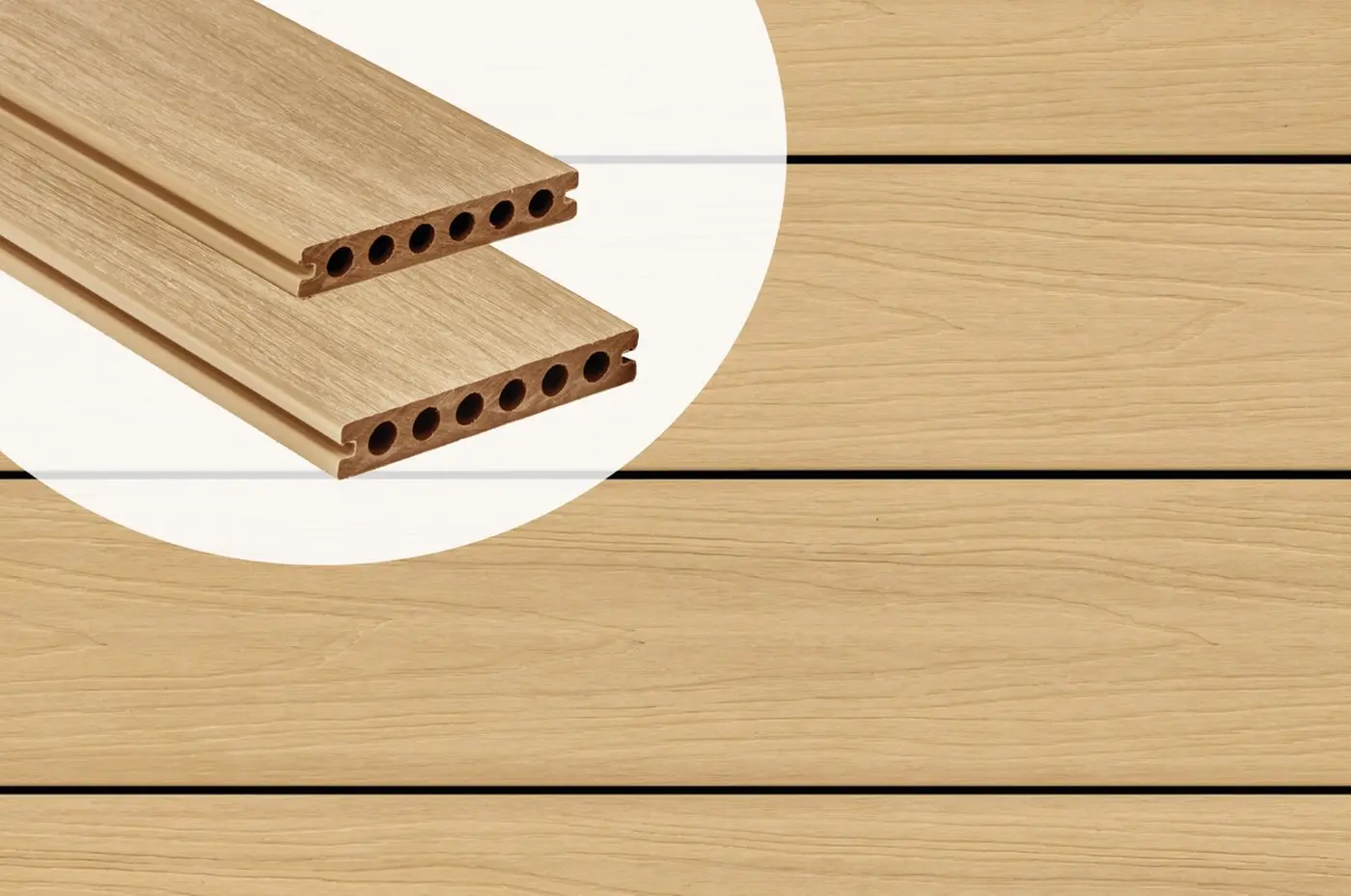
- Sandstone (Puraboard): a pale, sandy beige for when grey feels too cool.
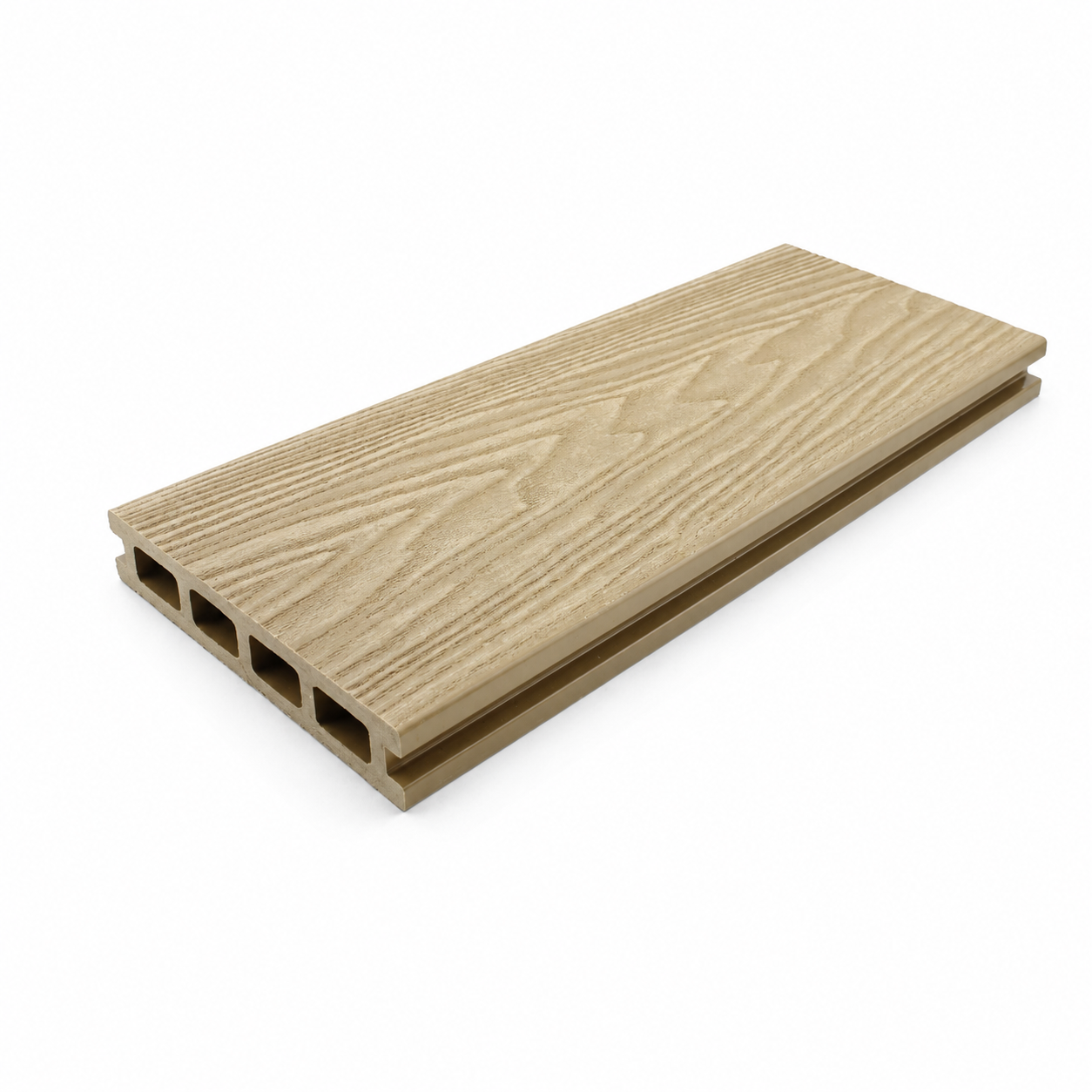
- Oak (PuraPro, PuraPlus, PuraPrime): a warm mid-tan that sits well beside brick and stone, as on PuraPlus Oak decking.
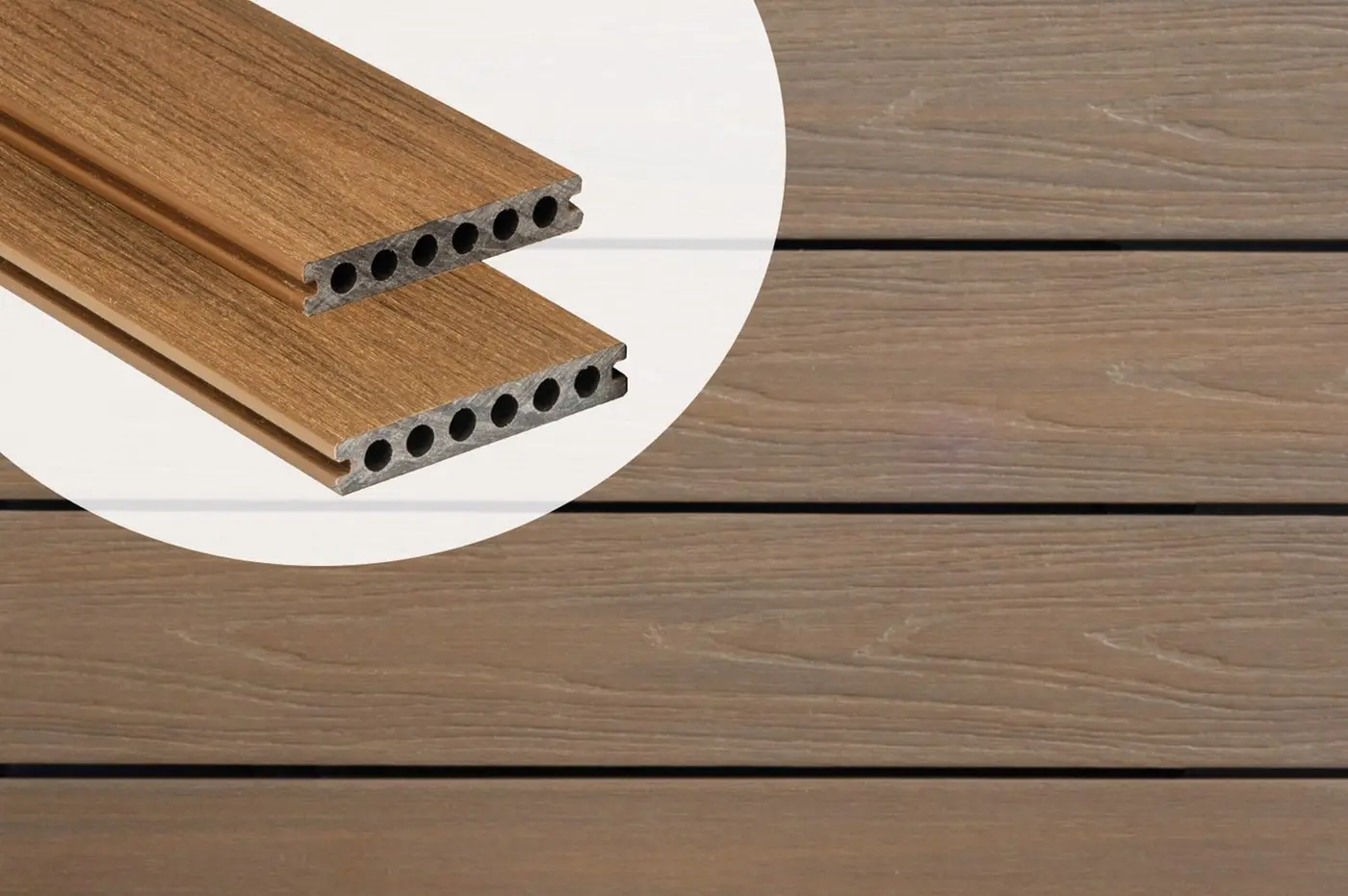
- Cedar, Teak (PuraShield), Golden Teak and Chestnut (Puraboard): honey to red-brown mid tones.
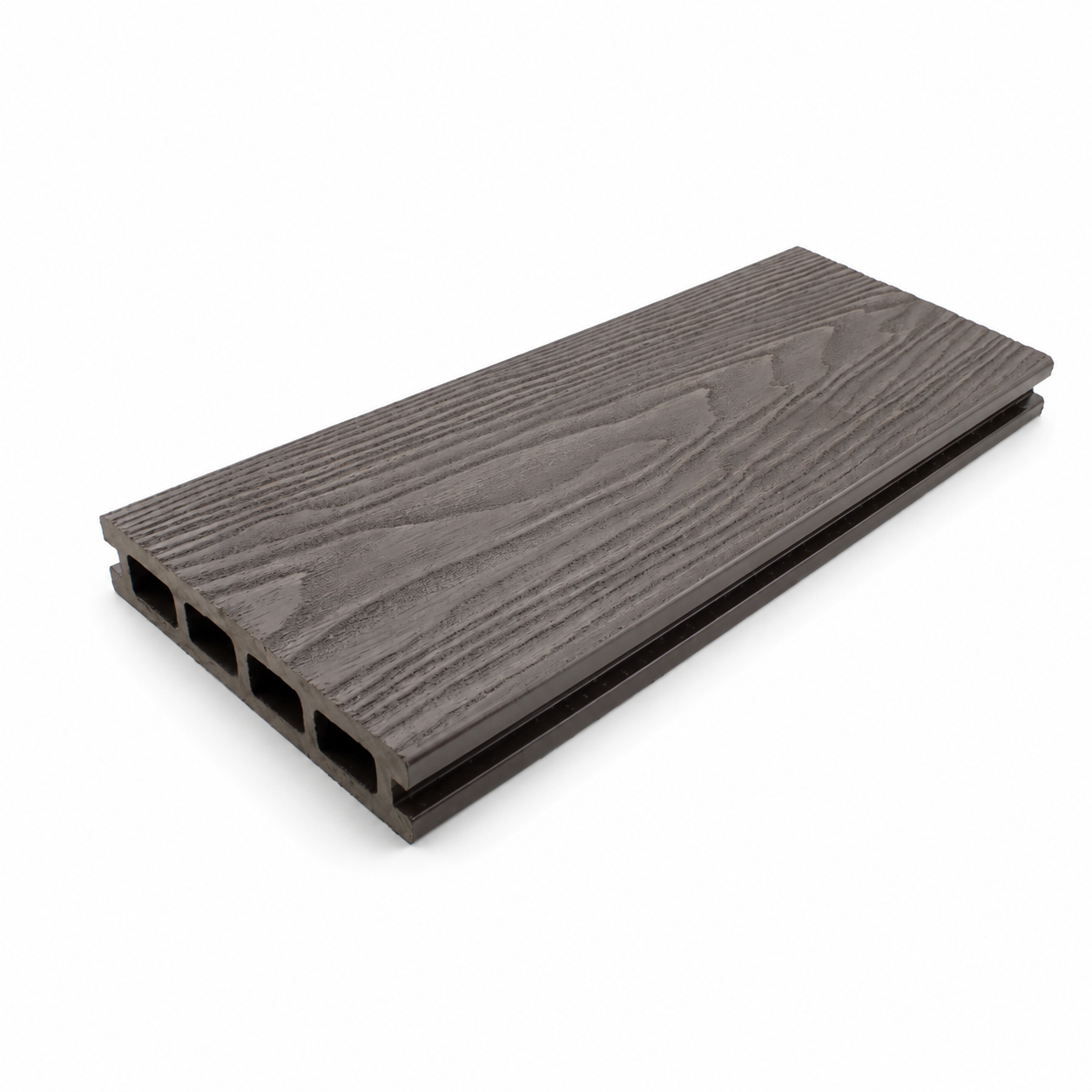
- Walnut (PuraPro, PuraPlus, PuraPrime) and Ipé (PuraShield): the deepest browns.
Is Composite Decking Non-Slip?
Every board we stock has a textured, grooved or grained face for grip, and several ranges have been slip tested. PuraPro and PuraPlus were rated low slip risk, wet and dry, in pendulum tests to BS 7976-2. PuraPrime scores at least 36 PTV wet and dry, and its reverse face is ribbed for extra grip, which makes it our pick for non slip composite decking on steps, shaded decks and pool surrounds. PuraShield is rated R10 on the ramp test, and solid Puraboard R11, the highest grip rating in our range. Whatever you choose, keep the deck clear of moss and wet leaves, which are what usually make a deck slip.
Fire Rated Composite Decking
PuraPro, PuraPlus and PuraPrime are classed Cfl-s1 under EN 13501-1, the European reaction-to-fire standard. The “fl” means the board was tested as a floor covering, C is a middle class on a scale that runs from A1 (non-combustible) down to F, and s1 means very little smoke. Puraboard is classed Dfl-s2, one class lower on the same scale. Our specifications don’t list a fire class for PuraShield, so if your project needs a Cfl-s1 deck, choose one of the three hollow ranges.
Composite Decking Prices in Ireland
Every board’s current price is shown in the grid above. Width, length and finish all play a part, but the biggest thing that sets the price of composite decking is how the board is built:
- Hollow boards (PuraPro, PuraPlus, PuraPrime): the lowest cost per square metre, and a sound choice for most gardens. PuraPro is the cheapest way into composite.
- Capped boards (PuraShield): cost more, because the protective cap is extra material made in an extra step.
- Solid boards (Puraboard): cost the most, because the board is solid all the way through.
Boards come in different widths and lengths, so compare ranges by the price per square metre (m²), not the price per board. A wider board covers more of the deck on every run, so a board that costs less each can work out dearer across a whole deck once you count how many you need.
How many boards you need
Enter the size of your deck in the calculator on any board’s product page and it works out how many boards you need. Once you add the boards to your cart, the extras that go with them are added automatically, so the total you see is for the whole deck, not just the boards.
Composite Decking vs Timber and Plastic Decking
Composite sits between real timber and boards made only of plastic. Here is the trade-off with each, so you can tell whether composite is the right material for your deck.
Composite or timber decking?
Timber is real wood, it usually costs less up front, and it can be sanded and re-oiled when it wears. The trade-off is upkeep: it needs oiling or staining every year to keep its colour and stay sound. Composite costs more at the start but needs only a wash. If you want real wood, compare our timber decking.
Composite or plastic decking?
People often search for plastic decking boards or PVC decking when they mean composite, but the two are different. PVC boards are made entirely of plastic. Composite blends wood fibre into the plastic, which gives a warmer, more natural look and a grain you can feel underfoot. Four of our five ranges are made this way. Puraboard is the exception: a solid polyurethane board with no wood in it, sold with our composite decking because it does the same job.
Composite Decking Joists, Pedestals and Fixings
A composite deck is only as good as the frame under it. Each range has its own installation manual with the full detail, and the basics are the same for every range:
- Frame: set the joists at 350 mm centres or closer for the hollow and capped boards, or 400 mm for Puraboard, on composite or timber decking joists, or on adjustable decking pedestals over a flat roof, balcony or uneven slab.
- Fixing: hidden clips hold each hollow or capped board down and set the gap between boards, while Puraboard is screw fixed with PuraFix screws. Find clips and screws in our decking screws and fixings.
- Expansion gaps: composite grows and shrinks with temperature in both directions, so leave the gaps your manual gives at board ends, walls and fixed edges. PuraShield needs slightly wider end gaps than the uncapped boards.
- Cutting: standard woodworking tools do the job; use a fine-toothed blade, and cut PuraShield at a moderate speed, because its cap is harder than the core.
- Edges: finish hollow ends and the deck perimeter with matching edge boards, bullnose or composite decking trims and fascia. Order them with the boards so the tones come from the same batch.
Wash the deck with warm water and a brush a couple of times a year, and rinse off fallen leaves in autumn before they stain. Keep a pressure washer off full power, because it can mark the grain. The colour mellows a little in the first months outside, then settles.
Composite Decking in Dublin and Across Ireland
You can see every composite decking range and colour in our Dublin showroom, and collect your order there. Outside Dublin, we deliver across Ireland, from Cork to Donegal. Substructures, trims and the rest of our decking boards are in our decking range.
Frequently Asked Questions About Composite Decking
Is composite decking slippery when wet?
Every board we stock has a textured, grooved or grained face that gives you grip when the deck is wet. For the most grip, PuraPrime has a ribbed anti-slip reverse face you can lay uppermost. Like any outdoor surface, keep it clear of moss, algae and wet leaves, which are what usually make a deck slip.
Does composite decking need expansion gaps?
Yes. Composite grows and shrinks with temperature, so leave gaps at board ends, against walls and at any fixed edge. On clipped boards the hidden clips set the gap between boards for you; on screw fixed Puraboard, leave 4 mm between boards and 5 mm at the perimeter. The installation manual for your range gives the exact gap to leave in each direction.
How far apart should the joists be?
Our hollow and capped composite boards are designed for joists at 350 mm centres or closer, measured from the middle of one joist to the middle of the next. Solid Puraboard needs joists at 400 mm centres for a straight lay, and closer on the diagonal. Each range’s installation manual has the full joist tables.
Can I cut and screw composite decking?
Yes. It cuts with standard woodworking tools, and a fine-toothed blade gives the cleanest edge. Hollow and capped boards are fixed with hidden clips, while solid Puraboard is screw fixed only, top fixed or side fixed with PuraFix screws. Hollow boards shouldn’t be screwed through their open ends, so finish those with a matching trim or fascia.
Does composite decking fade?
The colour mellows a little once the deck is outside, then holds steady. PuraPro, PuraPlus and PuraPrime settle over the first year, and PuraShield over the first six months. PuraShield’s colour sits within its protective cap, so it resists fading and staining better than an uncapped board.
Is composite decking fire rated?
PuraPro, PuraPlus and PuraPrime are classed Cfl-s1 under EN 13501-1, a middle class for floorings on the European reaction-to-fire scale that runs from A1 (non-combustible) down to F. Puraboard is classed Dfl-s2, one class lower. Our specifications don’t list a fire class for PuraShield, so if your project needs a Cfl-s1 deck, choose one of the three hollow ranges.
Can I lay composite decking on a balcony or flat roof?
Yes, where the structure below can carry a deck. On a balcony, flat roof or uneven slab, the joists usually sit on adjustable pedestals instead of being fixed down. Our PuraFix pedestals come in four height ranges, from 10 to 45 mm up to 110 to 210 mm, and you twist each one to level the frame.
What warranty does composite decking have?
It depends on the range. PuraPro and PuraPlus carry a manufacturer warranty of 15 years for residential use and 10 years for commercial use, PuraPrime carries 15 years, and the capped PuraShield carries 25 years for residential use and 15 years for commercial use. Keep your receipt with the installation manual for your range.